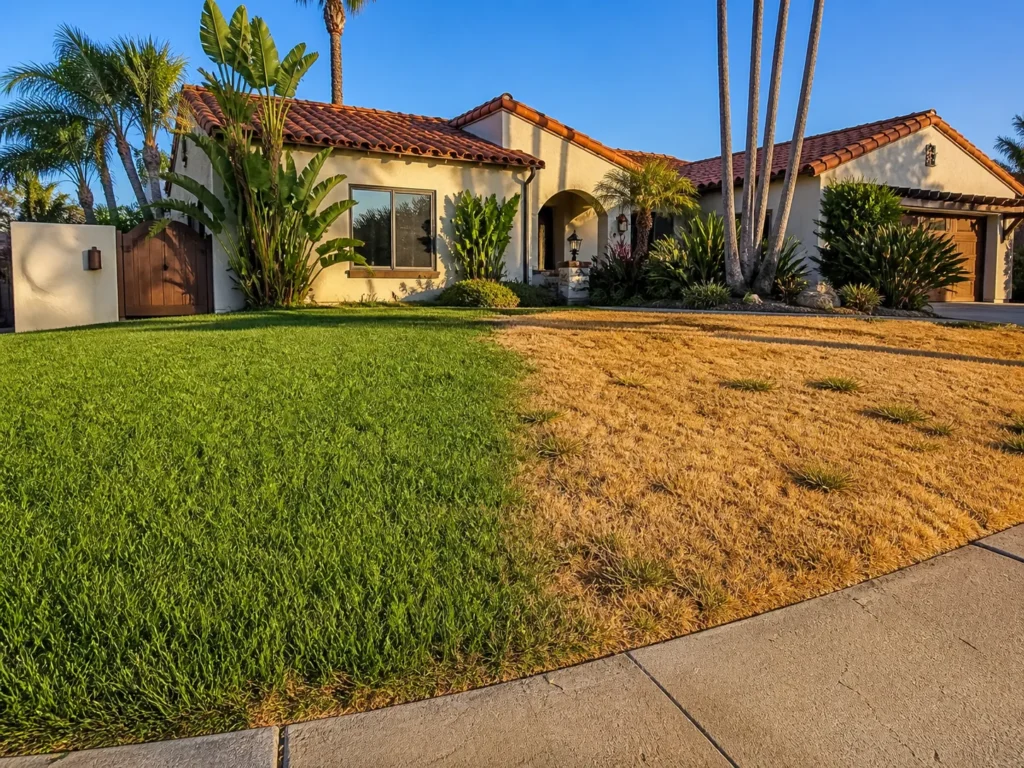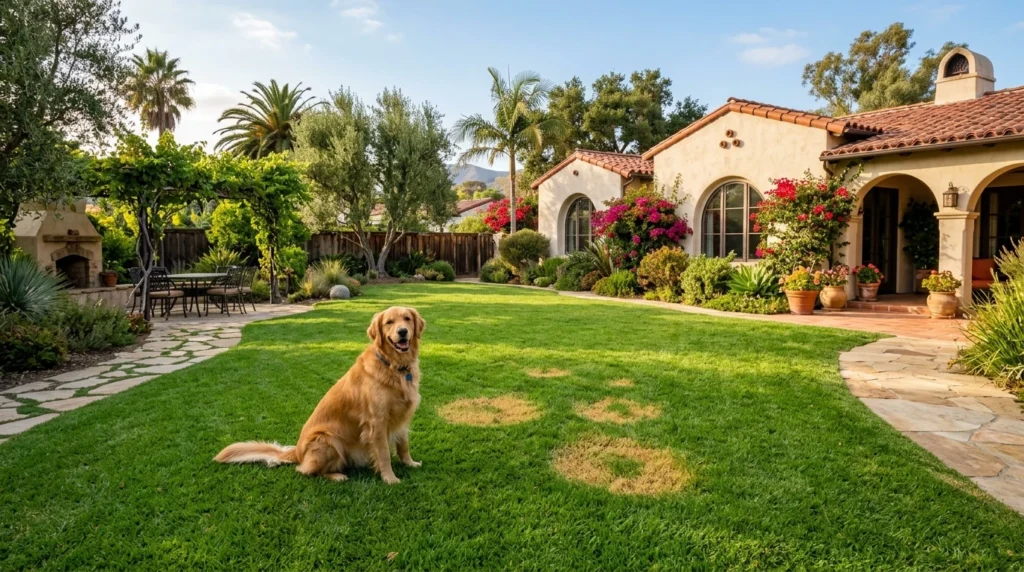
A homeowner in Eastlake Vistas called us in June with three brown circles spreading across her backyard Bermuda lawn. She had already applied a bag of patch repair mix from Home Depot. The circles kept growing.
The problem: she treated the symptom without diagnosing the cause. The brown circles were spring dead spot — a fungal disease that infected her Bermuda during the wet winter months. Applying grass seed on top of active fungal infection guaranteed failure. The seed germinated briefly and died.
Patchy lawn repair Chula Vista homeowners attempt most often fails for exactly this reason. The fix depends entirely on the cause — and Chula Vista lawns have eight distinct causes that each require a different response. Treating the wrong one wastes money and time. This guide covers all eight, a visual diagnosis table, and the correct repair process for Bermuda and fescue lawns in our specific climate.
Why Bare Patches Develop in Chula Vista Lawns (And What Patchy Lawn Repair Chula Vista Actually Requires)
Chula Vista’s climate creates bare patch conditions that don’t exist in cooler, wetter climates. Clay-heavy soil, inland summer heat, Otay Water District conservation schedules, and year-round pest pressure mean bare patches develop faster — and through more pathways — than national guides suggest.
Eight causes account for almost all patchy lawn repair Chula Vista homeowners need:
| Cause | Visual Pattern | Most Common In | Season |
|---|---|---|---|
| Soil compaction | Even thinning across high-traffic areas | Clay soil lots, play areas | Year-round |
| Drought stress | Uniform browning in sun-exposed zones | Any neighborhood | May–September |
| Fungal disease (Brown Patch) | Circular rings, darker border | Coastal-adjacent areas | September–November |
| Spring dead spot | Circular brown patches, 6–18 inches | Bermuda lawns | February–April |
| Grub damage | Spongy turf, lifts like carpet | Any neighborhood | July–September |
| Dog urine | Small circles with dark green ring border | Anywhere with dogs | Year-round |
| Shade stress | Gradual thinning under trees or structures | Older neighborhoods, Terra Nova | Year-round |
| Scalping damage | Even browning after mowing | Any maintained lawn | April–October |
Most bare patches in Chula Vista trace back to one of these eight. Patchy lawn repair Chula Vista homeowners get right starts with identifying the pattern first — then repairing accordingly.
Cause #1: Soil Compaction — The Silent Patchy Lawn Repair Chula Vista Culprit
Compacted soil blocks roots from getting oxygen, and that stifles growth. Compaction is the most common underlying cause of bare patches in Chula Vista — and the most frequently missed.
Chula Vista’s clay-heavy soils compact under foot traffic, irrigation pressure, and play equipment weight faster than sandy soils do. Roots confined to the top 2–3 inches of compacted soil are dramatically more vulnerable to every other stress: drought, heat, disease, and pests.
How to confirm compaction:
Push a standard flathead screwdriver into the soil in a bare patch the day after irrigation. If it stops at 2–3 inches, compaction is the issue. If it slides to the handle, look at the other seven causes instead.
Repair:
- Core aerate the affected area — and the entire lawn if compaction is widespread
- Apply gypsum (calcium sulfate) at 1 lb per 10 sq ft over the aerated area. Gypsum breaks up clay structure and improves drainage in Chula Vista’s soil type specifically.
- Top-dress with a thin layer (¼ inch) of compost over the aerated area
- For Bermuda: allow 3–4 weeks for the turf to fill back in through stolon spread
- For fescue: overseed the thin area at 8 lbs per 1,000 sq ft after aeration
Prevention: Aerate once per year in March for Bermuda. Avoid parking vehicles on lawn areas. Redirect foot traffic with stepping stones in high-use zones.
Widespread compaction across your Chula Vista lawn? Our lawn care services include annual spring aeration — the most impactful single treatment for bare patch prevention in our clay soil.
Cause #2: Drought Stress — The Most Misdiagnosed One
Drought stress is the first thing most patchy lawn repair Chula Vista homeowners blame for bare patches. It’s also the most frequently misdiagnosed — because it looks identical to several other problems at a glance.
True drought stress produces even browning across sun-exposed areas, particularly zones furthest from sprinkler heads. Grass blades curl inward. Footprints don’t spring back. The screwdriver test stops at 2 inches — bone-dry soil.
The Chula Vista context: many homeowners reduce watering in fall to comply with Otay Water District guidelines, then are surprised when Bermuda still shows stress. The schedule was often reduced too early — before Bermuda’s active season fully ended in October or November.
Repair for drought-stressed Bermuda:
- Water deeply for 3 consecutive days (25–30 min per zone) at 5 AM
- Move to a consistent 3-day-per-week schedule
- Most drought-stressed Bermuda recovers in 7–10 days if roots are alive
- Tug gently on brown grass. If roots resist, the plant is alive. If the mat lifts freely, the grass is dead.
Repair for drought-stressed fescue: Recovery is slower than Bermuda. Apply water immediately and expect 2–3 weeks of recovery. Fescue stressed for more than 3 weeks during summer may need fall overseeding — it rarely rebounds fully on its own.
Cause #3: Fungal Disease — Brown Patch and Spring Dead Spot
Bare spots are usually caused by soil compaction, lawn disease, pest damage, dog urine, heavy traffic, or shade stress. In Chula Vista, two fungal diseases account for most disease-related patches.
Brown Patch (Rhizoctonia Solani): Creates circular or irregular brown areas a few inches to several feet across, often with a darker outer ring. Spreads fastest during September–November when days are warm and nights cool with marine moisture. Evening watering accelerates spread dramatically.
Spring Dead Spot — the Chula Vista-specific one most guides miss: A Bermuda fungal disease caused by Ophiosphaerella species. It infects root systems during winter dormancy. When Bermuda breaks dormancy in spring, infected areas fail to green up — circular dead zones 6–24 inches across, sometimes ringed by normal green Bermuda.
This is exactly what the Eastlake Vistas homeowner had. Patch repair mix didn’t work because the soil was still harboring active infection. Seed applied over active infection dies within weeks.
Visual identification:
- Drought stress: even browning, no distinct circular shape
- Brown Patch: circular with a darker border ring
- Spring Dead Spot: circular, appears in April as surrounding Bermuda greens up around it
Repair:
- Do not reseed or replug until the fungal infection is treated
- Apply a registered fungicide (azoxystrobin or propiconazole) to the patch plus a 2-foot buffer
- Stop all evening watering — spores spread through wet nighttime conditions
- Allow 2–3 weeks for the fungicide to work before assessing recovery
- Brown Patch: Bermuda often self-recovers once disease pressure is removed
- Spring Dead Spot: treat soil, then reseed or plug in May–June after confirming infection is cleared
Cause #4: Grub Damage — A Patchy Lawn Repair Chula Vista Misdiagnosis
Treating the symptom without fixing the cause means the bare spot comes back. Grub damage is the most dramatically misdiagnosed cause because it looks identical to drought stress from ten feet away.
The carpet lift test: Grab a handful of grass in the patch and pull. If it peels back like loose carpet with almost no root resistance, grubs have eaten the roots. You’ll often find white C-shaped larvae 1–2 inches below the surface.
White grubs feed on roots from below. By the time bare patches appear, the roots are already gone. In Chula Vista, grub damage peaks in July through September. Secondary sign: skunks, raccoons, or birds digging in specific spots — they can smell grubs and excavate to reach them.
Repair:
- Apply curative grub treatment when grubs are confirmed (check current California product registration)
- Water the treatment in thoroughly so it reaches the root zone
- Allow 2 weeks for treatment to work before patch repair
- For Bermuda: once grubs are suppressed, stolons fill small patches (under 6 inches) naturally within 4–6 weeks
- Apply preventive grub treatment in May–June the following year to break the lifecycle
Widespread grub damage or uncertain diagnosis? Our lawn care team identifies the cause at first assessment — not a broad spray that stresses unaffected turf.
Cause #5: Shade Stress — Slow But Consistent
Shade stress is the most gradual cause. It develops over months as trees grow or structures change — sparse blades, then patchy coverage, then bare soil.
Bermuda needs 6–8 hours of direct sun daily. Below that threshold it thins progressively. In older Chula Vista neighborhoods — Terra Nova, parts of Rancho Del Rey, and western Chula Vista — mature tree canopy creates shade Bermuda can’t survive.
Repair for shade stress: If shade covers more than 30% of a lawn zone and is permanent, Bermuda repair attempts will fail repeatedly. The cause doesn’t change.
- Replace Bermuda in shaded zones with St. Augustine grass, or ground covers (Dymondia, lantana, mondo grass) where lawn isn’t needed
- For transitional shade: adjust sprinkler coverage for faster moisture loss at shaded perimeters
- Consult an arborist about selective canopy thinning — 20% canopy reduction sometimes restores enough sun for Bermuda to recover
The Bermuda Self-Repair Advantage: The Patchy Lawn Repair Chula Vista Shortcut
This is the most valuable thing patchy lawn repair Chula Vista Bermuda homeowners should know — and the one most guides skip.
Bermuda’s lateral growth via stolons and rhizomes lets it fill bare spots caused by cleats, paws, or foot traffic on its own. For patches under 6 inches in diameter, Bermuda self-repairs without seeding, sodding, or plugging — provided the underlying cause is removed.
The self-repair process:
- Healthy Bermuda spreads aggressively through above-ground stolons and below-ground rhizomes
- It fills small bare zones within 4–8 weeks during active season (March–October)
- Timeline depends entirely on removing the cause: fix compaction, treat grubs, stop the urine source, correct the watering gap
When to intervene with seed or plugs instead:
- Patches over 6 inches — stolon spread is too slow
- Multiple merged patches (over 12–15% of lawn area)
- Late-season damage (October or later) — stolons won’t reach before dormancy
- Any patch caused by fungal infection — wait for clearance first
Fescue does NOT self-repair. It grows in clumps, not runners. Every fescue bare patch needs manual overseeding.
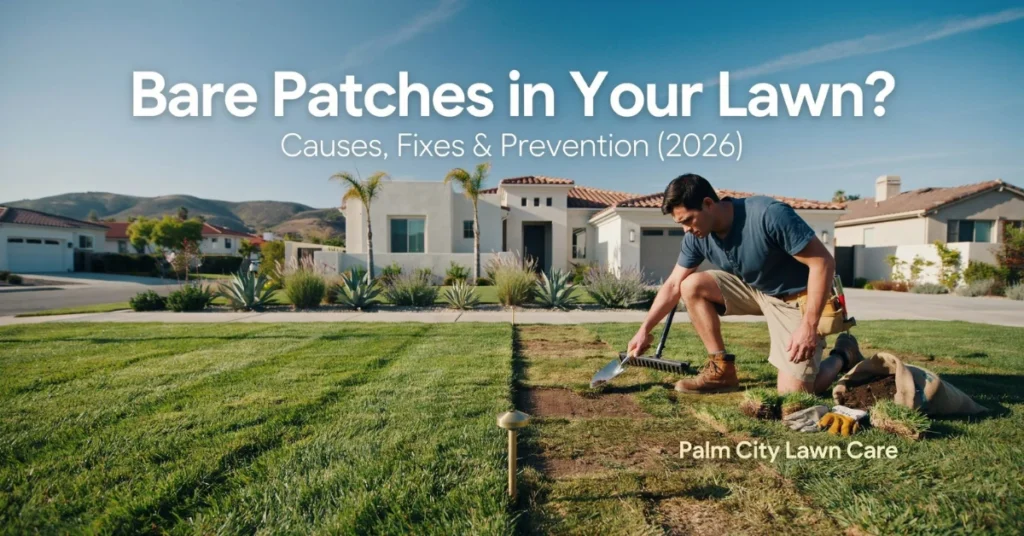
Step-by-Step Patchy Lawn Repair Chula Vista: Bermuda Grass
Step 1: Diagnose the cause first. Use the visual pattern table above. Seeding into active fungal infection, active grubs, or untreated compaction produces temporary results at best.
Step 2: Treat the cause. Aerate for compaction. Fungicide for disease. Grub treatment for pests. Flush with water for dog urine. Wait for confirmation (1–3 weeks) before starting repair.
Step 3: Prepare the bare soil.
- Rake out all dead material down to bare soil
- Loosen the top inch with a hand cultivator or garden fork
- Apply gypsum at 1 lb per 10 sq ft for clay soil and water in
Step 4: Choose repair method by patch size.
- Under 6 inches: do nothing — let stolon spread handle it with consistent watering
- 6–18 inches: Bermuda plugs (4-inch spacing) or patch repair mix
- Over 18 inches: sod is faster and more reliable than seed
Step 5: Water consistently until established. Twice-daily light watering for 14 days. Block foot traffic with a temporary fence if needed.
Step 6: Return to normal maintenance. After 14 days, resume your regular schedule. Delay mowing until new growth reaches 2 inches.
Step-by-Step Patchy Lawn Repair Chula Vista: Tall Fescue
Fescue repair follows different timing rules. This is the most important difference for Chula Vista homeowners to understand.
Timing is critical: Fescue seed germinates best at 55–70°F soil temperature. In Chula Vista, that means two windows:
- Fall (September–November): the primary fescue repair season
- Spring (February–March): shorter, works for minor patches
Never overseed fescue in June, July, or August. Soil temperatures regularly exceed 80°F. Germination drops sharply and seedlings die before establishing. Money and seed wasted.
Repair steps:
- Diagnose and treat the underlying cause
- Rake dead material to bare soil
- Loosen and amend soil with organic compost — fescue benefits from this in clay
- Seed at 8 lbs per 1,000 sq ft for bare areas, 4 lbs for thin areas
- Cover lightly with peat moss or straw
- Water twice daily until germination (10–14 days), then daily until established at 2 inches
If discovered in summer: treat the soil, protect the area with light mulch, and wait for the September window. Summer fescue repair wastes time and seed.
Prevention Checklist: Stopping Patchy Lawn Repair Chula Vista Problems Before They Start
Most patchy lawn repair Chula Vista homeowners do is reactive. These six habits make it preventive:
- [ ] Aerate annually in March — breaks compaction before it creates bare zones in clay soil
- [ ] Apply pre-emergent in late February — keeps weeds from invading thin areas
- [ ] Never water in the evening — Brown Patch and Spring Dead Spot both spread overnight
- [ ] Mow at correct height — Bermuda 1–1.5 in, fescue 3–4 in. Scalping creates patches within days in summer
- [ ] Flush dog urine spots within 60 minutes — prevents nitrogen burn from becoming a dead zone
- [ ] Walk your sprinkler zones monthly — coverage gaps create the same dry spots every summer
Recurring bare patches in the same spot every year? That’s a structural problem — compaction, irrigation gap, or drainage. Our irrigation and sprinkler team diagnoses and fixes the root cause. Our weed control service prevents weeds from colonizing bare zones during repair.
Patchy Lawn Repair Chula Vista Costs in 2026
| Repair Type | DIY Cost | Professional Cost | Notes |
|---|---|---|---|
| Core aeration (full lawn) | $80–$120 rental | $150–$300 | Do once per year in spring |
| Gypsum treatment | $15–$30 (25 lb bag) | Included with aeration | Apply together for best results |
| Fungicide application | $40–$80 product | $80–$180 | Requires CDPR QAL for commercial use |
| Grub treatment (curative) | $50–$100 product | $100–$200 | Time with grub life cycle |
| Bermuda plugs (per flat) | $25–$60 | — | Covers ~30 sq ft per flat |
| Bermuda sod (per pallet) | $350–$550 | $600–$900 installed | Best for large dead zones |
| Fescue overseeding (1,000 sq ft) | $30–$60 seed only | $150–$300 full service | Fall only in Chula Vista |
| Full lawn renovation | — | $800–$2,500 | When patches exceed 40% of lawn |
See our Chula Vista lawn care pricing guide for current 2026 rates. If bare patches cover more than 30–40% of your lawn, full renovation beats spot repair — our landscaping team can assess which makes sense for your yard.
FAQ: Patchy Lawn Repair Chula Vista — Your Questions Answered
What causes bare patches in Chula Vista lawns?
Eight causes account for most cases: soil compaction, drought stress, fungal disease (Brown Patch or Spring Dead Spot), grub damage, dog urine, shade stress, scalping from incorrect mowing height, and sprinkler coverage gaps. Correct identification before repair matters most — the wrong treatment makes most causes worse.
How do I tell drought stress apart from grub damage?
Try the carpet lift test. Pull gently on the brown grass. If it lifts freely with almost no root resistance, grubs ate the roots — treat for insects before reseeding. If the grass resists and stays rooted, drought stress is more likely — fix the watering schedule first.
Can Bermuda grass repair bare patches on its own in Chula Vista?
Yes — for patches under 6 inches during active season (March–October). Bermuda spreads through stolons and rhizomes and fills small bare zones naturally within 4–8 weeks once the cause is removed. Patches over 6 inches need plugs or sod.
When is the best time to repair bare patches in Chula Vista?
Bermuda: May through September, when soil above 65°F supports fast establishment. Fescue: September through November is the primary window. Never overseed fescue in summer — soil above 80°F kills germinating seedlings.
What is spring dead spot and how do I know if I have it?
A fungal disease that infects Bermuda roots during winter dormancy. When Bermuda greens up in spring, infected patches stay brown in circular zones 6–24 inches across while surrounding grass greens normally. Treatment requires fungicide before reseeding — seeding into active infection fails.
How much does patchy lawn repair cost in Chula Vista?
Core aeration runs $150–$300 professionally. Fungicide treatment costs $80–$180. Grub treatment runs $100–$200. Sod for large dead zones runs $600–$900 per pallet installed. Full renovation for widespread damage costs $800–$2,500. See our pricing page for current rates.
Why do my bare patches keep coming back in the same spots?
The underlying cause wasn’t addressed before repair. Recurring patches in the same spot every year usually mean a structural issue: a sprinkler coverage gap, unaerated compaction, an incompletely treated fungal infection, or a shade condition Bermuda can’t overcome.
Do I need a professional for patchy lawn repair in Chula Vista?
Minor patches under 6 inches are DIY-friendly for Bermuda homeowners. Fungal disease (needs identification plus licensed commercial application), grub infestation, or coverage above 15–20% of the lawn benefit from professional assessment. Treating the wrong cause repeatedly costs more than a single professional diagnosis.
The One Rule That Changes Everything for Bare Patch Repair
Every patchy lawn repair Chula Vista attempt without first identifying the cause ends the same way: temporary improvement, then recurrence.
The Eastlake Vistas homeowner’s spring dead spot didn’t respond to patch repair mix because the fungal infection in the soil was still active. New seed germinated, contacted the infection, and died. The circle stayed bare — and grew slightly wider.
Fix the cause. Wait for confirmation. Then repair.
In Chula Vista specifically, that sequence matters more than elsewhere because of the variety and persistence of our stressors. Compaction doesn’t go away on its own. Spring dead spot reinfects the same spots year after year if untreated. Grubs complete their lifecycle and their offspring repeat the damage the following July.
The homeowners in Eastlake, Otay Ranch, and Rancho Del Rey with consistently beautiful lawns don’t have better luck. They identified their bare patch causes once, treated them correctly, and shifted to the prevention checklist above.
That’s the entire difference between repairing bare patches every summer and never having them again.
What does the bare patch in your lawn look like — and does it lift like carpet or stay rooted?
Serving all Chula Vista neighborhoods including Eastlake, Otay Ranch, and Bonita. CSLB licensed. Fully insured. Diagnosis-first approach on every property visit.