Lawn Renovation Chula Vista, CA | Lawn Restoration Service
Most struggling Chula Vista lawns don’t need to be torn out. They need to be rebuilt from the soil up.
- Soil-First Restoration
- Dethatching & Overseeding
- Free Assessments
What Is Lawn Renovation?
Lawn renovation is a multi-step restorative process for lawns that are too damaged or thin to recover through normal maintenance, but not so far gone that full sod replacement is the only option. A complete renovation addresses the soil, the thatch layer, the compaction, and the grass coverage in the right sequence to rebuild a healthy, dense lawn from the root zone up.
A full lawn renovation Chula Vista program typically combines: – Soil assessment – evaluating pH, compaction, organic matter content, and drainage – Dethatching or power raking – mechanically removing excess thatch blocking the root zone – Core aeration – pulling soil plugs to relieve compaction and open channels for seed, water, and nutrients – Soil amendment – correcting pH and adding organic matter where needed – Overseeding or power seeding – introducing new grass seed into aeration holes and bare areas – Topdressing – applying a thin layer of compost or soil blend to improve seed-to-soil contact and organic matter – Starter fertilizer – high-phosphorus feeding to accelerate root establishment – Establishment watering schedule – precise irrigation guidance through the germination and rooting period
Not every lawn needs all of these steps. Part of what we do during the initial assessment is determine which components apply to your specific yard.
Soil assessment
evaluating pH, compaction, organic matter content, and drainage
Dethatching or power raking
mechanically removing excess thatch blocking the root zone
Core aeration
pulling soil plugs to relieve compaction and open channels for seed, water, and nutrients
Soil amendment
correcting pH and adding organic matter where needed
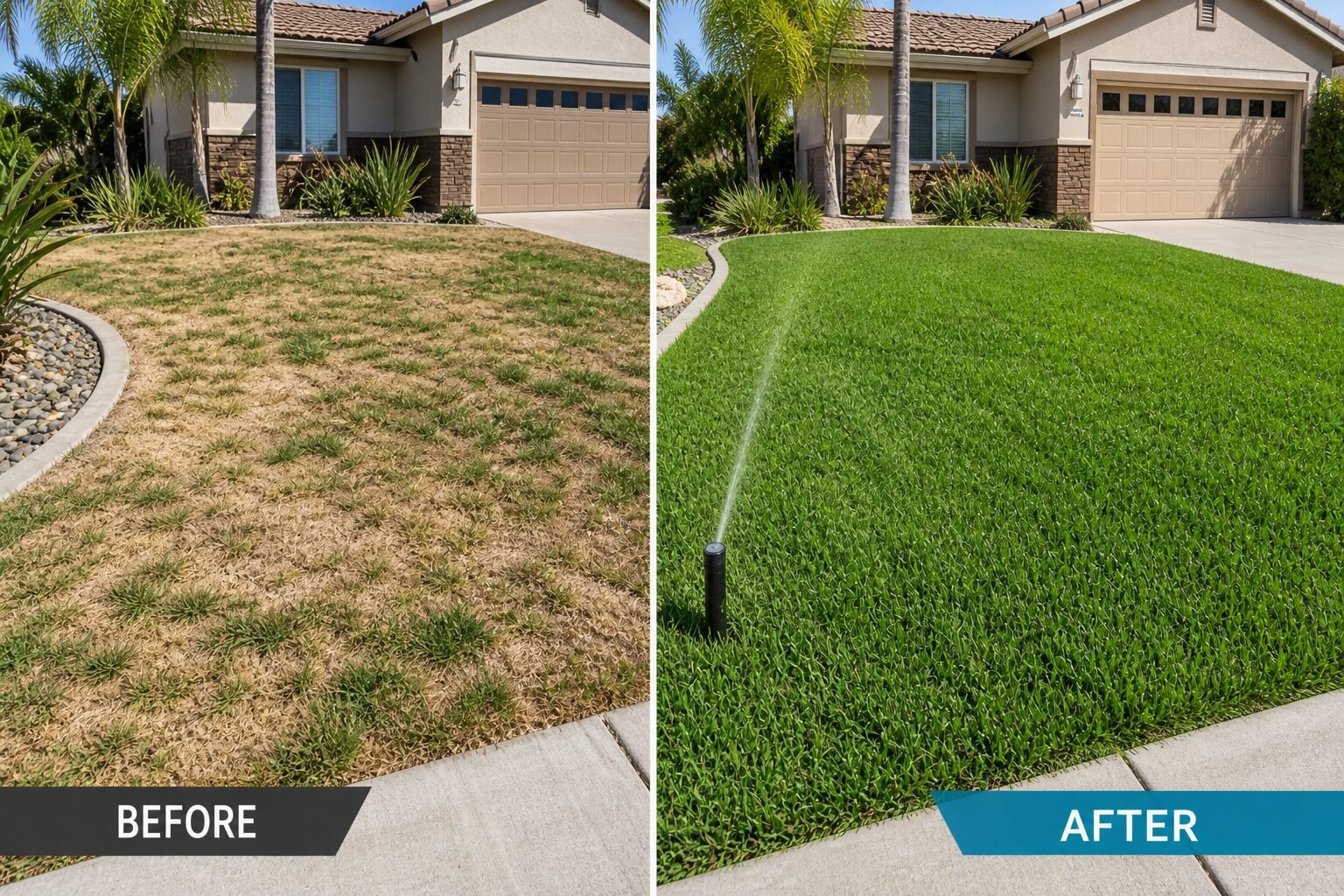
Renovation vs. Sod Replacement vs. Routine Maintenance — Which Does Your Lawn Need?
This is the most important decision Chula Vista homeowners face when a lawn is struggling. The wrong path costs more and delivers less.
| Condition | Coverage Still Living | Best Path | Timeline to Results |
|---|---|---|---|
| Thin or tired but mostly alive | 60–100% | Routine maintenance (aeration + fertilization) | 4–8 weeks |
| Significant bare patches, stressed, sparse | 30–60% | Lawn renovation | 6–12 weeks |
| Mostly dead, disease damage, root failure | Less than 30% | Sod installation | Same-day visual result |
| Starting fresh (new construction) | 0% | Sod installation | Same-day visual result |
The 30–60% rule: if you look at your lawn and roughly a third to two-thirds of it is still living grass – even thin, stressed living grass – renovation will outperform sod replacement on cost and deliver results within the same growing season. Below 30% living coverage, the economics of renovation don’t work as well; sod gives you a faster, more reliable outcome.
If you’re unsure which situation you’re in, we can assess your lawn in person and give you an honest recommendation. We’ll tell you clearly which approach makes sense for your specific yard – and we won’t push the more expensive option unless it’s genuinely the right one.
Signs Your Chula Vista Lawn Needs Renovation
Bare soil is visible in multiple areas
not just a small spot or two, but recurring bare patches that don't respond to watering
Fertilizer doesn't produce visible improvement
nutrients are sitting on a blocked, compacted surface rather than reaching roots
The thatch layer exceeds ½ inch
you can measure this by pushing a spade into the lawn edge and looking at the profile between the grass and soil
Water runs off or puddles
rather than soaking in within 15–20 minutes of irrigation
The lawn feels spongy and soft
(excessive thatch underneath) rather than firm and grounded
Grass pulls up easily
with little resistance — shallow roots without deep anchor in the soil
The lawn thinned significantly after a drought or irrigation failure
and hasn't recovered despite resumed watering
HOA notices about lawn appearance
that routine mowing and watering haven't resolved
Our Lawn Renovation Chula Vista Process — Step by Step
Step 1 — Site Assessment
We walk your property and evaluate: grass type, coverage percentage, thatch depth, soil compaction, drainage patterns, sun exposure, and any HOA-specific requirements you've shared. We also check your irrigation system to confirm coverage and pressure are adequate before we invest in renovation work — a poor irrigation setup can undo renovation results during the critical establishment period.
Step 2 — Dethatching
If your thatch layer exceeds ½ inch, we mechanically remove it using a power rake or vertical mower before any other steps. Bermuda grass accumulates thatch faster than most grass types due to its aggressive lateral growth — if the thatch isn't cleared first, overseeding on top of it produces poor germination and aeration holes fill with thatch rather than soil. After dethatching, the lawn looks rough — scalped, exposed, somewhat shocking to see. That's normal. You're looking at the soil profile now, which is exactly where the renovation work needs to happen.
Step 3 — Core Aeration
We run core aeration across the entire lawn immediately after dethatching. The hollow-tine aerator pulls 2 to 3 inch soil plugs, creating open channels that serve as ideal receptors for grass seed, water, and nutrients. Seed dropped into aeration holes germinates two to three times faster than seed scattered on intact turf. This step is non-negotiable in any serious renovation program.
Step 4 — Soil Assessment and Amendment
Chula Vista soils commonly test alkaline at pH 7.2 to 7.8. Bermuda grass performs best between pH 6.0 and 7.0. If pH correction is needed, we incorporate sulfur or organic matter at appropriate rates before seeding. We also assess organic matter content and add compost amendment where the clay soil needs improved water retention and microbial activity.
Step 5 — Overseeding or Power Seeding
We seed the lawn using a method matched to its condition: - Broadcast overseeding for lawns with moderate coverage and good aeration-hole receptivity - Slit seeding (power seeding) for more severely degraded lawns — this machine cuts shallow furrows directly into the soil and deposits seed at consistent depth and spacing, delivering better seed-to-soil contact and significantly higher germination rates than broadcast seeding We match the grass variety to your existing lawn or recommend a transition if the current variety is inappropriate for your site conditions.
Step 6 — Topdressing
We apply a ¼ to ½ inch layer of compost or custom soil blend over the seeded area. Topdressing serves three functions: it increases seed-to-soil contact by covering seeds lightly for better germination, adds organic matter to Chula Vista's clay-heavy soil, and helps moderate alkaline pH over successive renovations. It also smooths out minor surface irregularities that have accumulated from years of settling and compaction.
Step 7 — Starter Fertilizer and Watering Instructions
We apply a starter fertilizer high in phosphorus to drive root development during the establishment period. Then we walk you through the exact watering schedule for your grass type and the current season — including how to contact your water district for a renovation watering exemption if you're on Otay Water District or Sweetwater Authority service.
Bermuda Grass Renovation in Chula Vista — Timing and Techniques
Bermuda grass is the dominant warm-season grass in eastern Chula Vista – Eastlake, Otay Ranch, Rancho del Rey – and it has specific renovation windows that make a significant difference in outcomes.
Best renovation window: Late July through early September. Bermuda is at peak growth during this period, with soil temperatures around 70 to 75°F. A renovation done now gives Bermuda maximum recovery time before its November dormancy. By the time the grass goes brown for winter, the renovated areas have had eight to ten weeks of growth to fill in.
Spring renovation window: March through May. As Bermuda emerges from dormancy and begins active growth, this is the second viable window. Spring renovation works well but produces results later in the year and leaves less buffer before summer heat peaks.
What NOT to do: never dethatch or heavily aerate Bermuda during its dormant period (November through February). Dormant grass doesn’t have the metabolic resources to recover from aggressive mechanical treatment. Any lawn renovation Chula Vista timing question should start with “is the Bermuda fully green and actively growing?”
Thatch is the recurring challenge for Bermuda in Chula Vista. Bermuda’s aggressive stolons and rhizomes generate thatch faster than almost any other warm-season grass. If your Bermuda lawn is receiving good water and fertilizer and still looking thin, check the thatch depth before anything else. A ¾ inch thatch layer sitting between the grass and the soil will block everything – water, air, nutrients, and seed.
Winter Overseeding for HOA Compliance During Bermuda Dormancy
One of the most common and locally specific concerns for Chula Vista Bermuda grass homeowners is HOA compliance during the November through February dormancy period. Dormant Bermuda is brown. In communities like Eastlake and Otay Ranch, where HOA appearance standards are actively enforced year-round, a brown lawn in December can generate a notice even if the grass is perfectly healthy.
The solution is winter overseeding with perennial ryegrass.
Here’s how it works:
In late October – before Bermuda goes fully dormant – we scalp the Bermuda short (to about ½ inch), lightly dethatch or power rake, and broadcast perennial ryegrass seed at high density across the entire lawn. Ryegrass germinates quickly in cooler fall temperatures, typically visible within 7 to 10 days, and produces a full green lawn within two to three weeks.
The ryegrass stays green through winter while Bermuda rests underground. When temperatures warm in late April and May, Bermuda re-emerges and natural competition causes the ryegrass to fade as the season shifts. By June, you’re back to pure Bermuda.
This technique – called dormant overseeding or winter overseeding – is widely used on golf courses, sports fields, and high-HOA communities throughout Southern California. It’s the cleanest way to maintain year-round green on a Bermuda lawn in Chula Vista without switching to a different grass variety.
Note: winter overseeding is a specific renovation service for the October–November window only. It is NOT a substitute for full lawn renovation when the underlying Bermuda is damaged – if the Bermuda has density or root-zone problems, those need to be addressed in the summer renovation window before winter overseeding will perform well.
Lawn Renovation Chula Vista Cost
Dethatching / power raking
$160 – $300
Core aeration
$120 – $240
Broadcast overseeding
$150 – $500
Power seeding (slit seeding)
$400 – $900
Topdressing (compost)
$200 – $500
Soil amendment (pH correction)
$100 – $300
Renovation cost depends on the services your specific lawn requires, yard size, and the severity of the damage. Here’s a practical breakdown:
Cost factors specific to Chula Vista: – Thatch depth. Heavily thatched Bermuda lawns require more aggressive dethatching passes, increasing labor. – Soil amendment. Significant pH correction or organic matter addition on clay-dominant soil adds material cost. – Power seeding vs. broadcast. Power seeding produces better germination on severely thin lawns but costs more than broadcast overseeding. – Winter overseeding. If scheduled separately from the summer renovation, this is an additional service cost in October–November.
Call (619) 604-8495 for a free assessment. We look at your specific lawn before quoting – renovation costs vary too much by condition to give meaningful estimates without seeing the property.
After Your Lawn Renovation Chula Vista — Keeping It Going
The renovation establishes the foundation. What happens in the six to twelve months after determines whether the results hold long-term.
Establishment watering (weeks 1–4).
New seed needs consistent moisture — twice daily in the first week, tapering to once daily in week two, then normal schedule in week three. Notify your water district (Otay Water District or Sweetwater Authority) before starting if you're under their service area — both allow renovation watering exemptions for temporary schedule increases.
First mow (week 4).
Mow at 1.5 to 2 inches for Bermuda, 3 to 3.5 inches for ryegrass or fescue. Never remove more than one-third of the blade in a single cut. Mowing too low on newly germinated grass sets establishment back.
Follow-up fertilization (weeks 6–8).
Starter fertilizer is spent by the six-week mark. A follow-up maintenance application at the right NPK ratio locks in the density from your first growing cycle. Folding this into a seasonal fertilization program ensures the renovated lawn gets the right nutrients at the right times through the growing season.
Weed monitoring.
Newly overseeded lawns can be vulnerable to weed germination in the same bare areas the new grass is filling. Hold off on any pre-emergent weed control for at least six weeks after seeding — pre-emergents block grass germination along with weeds. After six weeks, normal weed management resumes.
Year 1 aeration.
After your first full growing season post-renovation, core aeration maintains the root-zone health you've rebuilt. The renovation reset compaction and soil structure; annual aeration prevents it from returning.
Frequently Asked Questions About Lawn Renovation Chula Vista
What is lawn renovation?
When is the best time for lawn renovation in Chula Vista?
How much does lawn renovation cost in Chula Vista?
What's the difference between renovation and sod installation?
What is dethatching and does my Chula Vista lawn need it?
Can I overseed Bermuda grass for winter color in Chula Vista?
What is topdressing and why does it matter?
How long before I see results?
Should I aerate before or after overseeding?
Can I water my lawn normally under Otay Water District rules after renovation?
Lawn Renovation Chula Vista Service Areas
We provide lawn renovation throughout Chula Vista, including the neighborhoods below.
Not sure if we cover your address? Call (619) 604-8495.
Eastlake
Bermuda grass renovation and winter overseeding; HOA compliance guidance for all 6 sub-associations
Otay Ranch
Full-service renovation including power seeding for larger degraded lots
Rancho del Rey
Established community with mature lawns that benefit from comprehensive renovation programs
Terra Nova
Compact residential lots; often one-season renovation candidates
Sunbow
Family neighborhoods with high foot traffic; thatch management typically needed
Bonita
Service extends to neighboring Bonita properties
Ready to Restore Your Lawn? Call for a Free Lawn Renovation Chula Vista Assessment
If your lawn is thin, patchy, or losing ground despite consistent watering and care, the problem is in the soil – and lawn renovation Chula Vista is the solution. We assess what’s actually holding your lawn back, build a targeted treatment sequence, and rebuild root-zone health in a single season.
We provide all lawn care services in Chula Vista, including renovation, core aeration, fertilization programs, weed control, sod installation, and irrigation repair. If renovation is the right path, we’ll tell you. If sod makes more sense, we’ll tell you that too.
Call (619) 604-8495 for a free lawn assessment. No contracts, no upsells – just an honest look at what your yard needs.