Lawn Fertilization Chula Vista, CA
Lawn fertilization is the process of applying essential nutrients – primarily nitrogen, phosphorus, and potassium – to turf at scheduled intervals to support healthy growth, root depth, and color. A properly fed lawn outcompetes weeds, recovers faster from heat stress, and holds its density through Chula Vista’s inland summers without relying on excess water.
- Soil-Matched Programs
- Bermuda & St. Augustine Specialists
- Free Estimates
What Lawn Fertilization Actually Does
Lawn fertilization is the process of applying essential nutrients – primarily nitrogen, phosphorus, and potassium – to turf at scheduled intervals to support healthy growth, root depth, and color. A properly fed lawn outcompetes weeds, recovers faster from heat stress, and holds its density through Chula Vista’s inland summers without relying on excess water.
The three primary nutrients in any fertilizer serve distinct functions:
- Nitrogen (N) drives leaf and blade growth, producing the deep green color and density that HOA inspectors and neighbors notice immediately.
- Phosphorus (P) supports root development, particularly important during establishment or after aeration in clay-heavy soils.
- Potassium (K) improves stress tolerance – heat, drought, and heavy foot traffic. Bermuda lawns in Eastlake and Otay Ranch need this through summer.
Beyond the N-P-K ratio, iron is the fourth variable that most Chula Vista homeowners don’t know about – and it’s the most common reason lawns here stay yellow despite regular watering and feeding. More on that below.
Nitrogen
Builds blade growth, density, and the deep green color HOA inspectors notice.
Phosphorus
Supports root development, especially after aeration in clay-heavy soils.
Potassium
Improves heat, drought, and foot-traffic stress tolerance.
Iron
Corrects the yellowing that nitrogen alone cannot solve in alkaline soil.
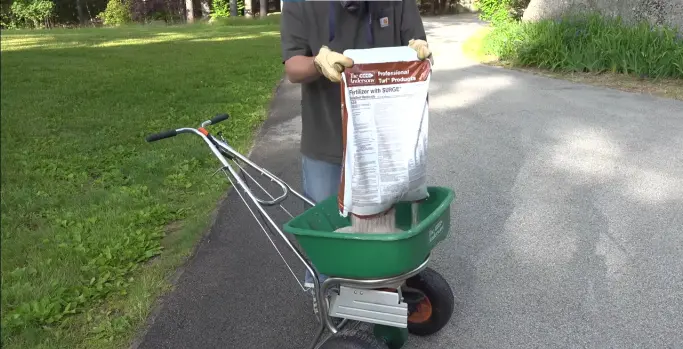
Soil-matched feeding keeps Chula Vista lawns dense through the inland summer.
Grass Types in Chula Vista and What They Need
Before any fertilization program can be designed, you need to know what you’re feeding. The most common grass types in Chula Vista are Bermuda, St. Augustine, and tall fescue, and each follows a completely different fertilization calendar.
Bermuda Grass
| Month | Application | Product Type |
|---|---|---|
| March–April | First spring feeding | 21-0-0 or 32-0-5 slow-release |
| May | Second feeding + iron foliar | High-N + liquid iron |
| June | Third feeding | Slow-release 32-0-5 |
| July | Light feeding (heat caution) | Reduced-rate application only |
| August | Fourth feeding | Standard slow-release |
| September–October | Pre-dormancy feeding | Lower-N, higher-K (for cold hardiness) |
| November–February | No feeding | Dormancy – skip entirely |
| Month | Application | Notes |
| --- | --- | --- |
| March | First feeding | 16-4-8 NPK with iron |
| May–June | Second feeding + iron spray | Critical iron treatment window |
| July–August | Third feeding | Monitor for burning during heat events |
| September–October | Fourth feeding | Reduce nitrogen, hold color before fall |
| November–February | No feeding | Slower growth – let it rest |
| Month | Application | Notes |
| --- | --- | --- |
| September–October | First (primary) feeding | This is fescue's most important feeding |
| November | Second feeding | Root-strengthening before cool months |
| February–March | Spring feeding | Light application only |
| May–August | No feeding (or minimal) | Heat stress – avoid pushing growth |
Bermuda is a warm-season grass. It goes dormant (turns straw-brown) from roughly November through February. Fertilizing a dormant Bermuda lawn is wasteful and can feed weeds instead of grass. Once soil temperatures hit 65°F in March, it breaks dormancy and enters active growth – that’s when feeding begins.
Bermuda fertilization schedule for Chula Vista:
Total feedings per year: 4 to 6, depending on lawn condition and weather.
St. Augustine Grass
St. Augustine grows in Chula Vista’s slightly more shaded and coastal-influenced properties – western Chula Vista, Bonita, and some Sunbow-area homes. It has a wider, coarser blade than Bermuda and is less drought-tolerant but tolerates moderate shade better.
St. Augustine’s most common nutrient problem in Chula Vista is iron deficiency. Our alkaline soils (pH 7.2 to 7.8 in most areas) lock out iron even when sufficient amounts are present. The visible sign is yellowing between leaf veins while the veins themselves stay green – a pattern called interveinal chlorosis. A liquid iron foliar spray corrects it within 3 to 7 days. A soil test identifies whether a pH correction is also needed long-term.
St. Augustine fertilization schedule for Chula Vista:
Tall Fescue
Fescue is the only common cool-season grass in Chula Vista. It stays green year-round but demands significantly more water than warm-season grasses – a real tension during Otay Water District and Sweetwater Authority irrigation guidelines. It’s best suited to shaded lots in western Chula Vista and Bonita where summer temperatures are moderated.
Fescue fertilization schedule for Chula Vista:
Why Chula Vista Soils Complicate Standard Fertilization Programs
Standard lawn fertilization Chula Vista advice from a bag or generic online guide ignores two soil conditions that make this city different from most of Southern California.
Alkaline pH and Iron Lockout
Most of Chula Vista – particularly the eastern master-planned zones – sits on soils with a pH between 7.2 and 7.8. At that alkalinity, iron becomes chemically unavailable to grass roots even when it exists in the soil. Applying more nitrogen fertilizer doesn’t fix this. The grass stays yellow because it can’t access what it needs.
The solution is a two-step approach: a liquid chelated iron foliar spray delivers bioavailable iron directly to the leaf blade for fast correction (visible results in 3 to 7 days), while a long-term soil acidification program – applying elemental sulfur in small, repeated doses – gradually shifts pH toward the 6.5 to 7.0 range where iron becomes naturally accessible.
Imported Construction Fill in Otay Ranch and Eastlake
Many Otay Ranch and Eastlake homes – particularly those built during the major 1990s and 2000s development phases – sit on imported construction fill rather than native topsoil. Fill composition varies significantly from lot to lot. Two homes on the same street can have meaningfully different soil nutrient profiles.
This is why a soil test on the first visit matters more in these neighborhoods than anywhere else. It takes the guesswork out of product selection and prevents applying nutrients the soil already has in excess while missing ones it lacks.
Alkaline pH
pH 7.2 to 7.8 can lock iron away from grass roots.
Construction Fill
Eastlake and Otay Ranch lots vary from property to property.
Targeted Response
A soil test prevents paying for nutrients your lawn already has.
Lawn Fertilization Chula Vista: Month-by-Month Calendar
This calendar covers Bermuda and St. Augustine – the two grass types in the vast majority of Chula Vista properties.
| Month | Action | Notes |
|---|---|---|
| January | Nothing | Bermuda dormant – do not fertilize |
| February | Nothing (pre-emergent weed control is critical this month – see our weed control program) | Soil too cold for fertilizer uptake |
| March | First feeding of the year | Bermuda breaking dormancy at 65°F – begin slow-release program |
| April | Second feeding + iron foliar | Peak green-up period, iron prevents spring yellowing |
| May | Third feeding | Active growth, apply on a cooler morning |
| June | Fourth feeding | Full growing season – check soil moisture first |
| July | Light or skip | Inland heat above 95°F – reduced rate only, risk of burn increases |
| August | Fifth feeding if skipped July | Monitor watering closely |
| September | Pre-dormancy feeding | Shift to higher-potassium product for cold hardiness |
| October | Final feeding | Last opportunity before dormancy – lower-nitrogen blend |
| November | Nothing | Begin dormancy management |
| December | Nothing | Bermuda dormant – save money, skip the feed |
Iron Deficiency: The Most Overlooked Lawn Problem in Chula Vista
Interveinal chlorosis – yellow blades with green veins – is widespread across Chula Vista, particularly in St. Augustine lawns in western Chula Vista and Bonita, and in Bermuda lawns on newer-construction lots in Eastlake and Otay Ranch where fill soil is alkaline.
How to identify iron deficiency: The yellowing appears first on the newest growth – young shoots and leaf tips – while older growth stays greener. If you see a general yellow-green color across the entire lawn, that’s more likely nitrogen deficiency. If you see yellow blades with distinctly green veins, that’s iron deficiency.
What doesn’t fix it: More water. More nitrogen. These are the two most common mistakes. Iron deficiency is a chemistry problem – applying more of what the lawn already has doesn’t address a missing micronutrient.
What does fix it:
1. Immediate: Liquid chelated iron foliar spray. Results visible in 3 to 7 days. Not permanent – the lawn will need it again on schedule. 2. Medium-term: Include iron in every spring and summer fertilizer application. 3. Long-term: Gradual soil pH correction with elemental sulfur over 2 to 3 seasons, shifting soil into the 6.5 to 7.0 range where iron is naturally plant-available.
Identify
Yellow blades with distinctly green veins point to iron deficiency.
Correct
Liquid chelated iron produces visible results in 3 to 7 days.
Prevent
Include iron in spring and summer applications and correct soil pH over time.
How Our Lawn Fertilization Chula Vista Service Works
We do not show up, guess, and leave. Every program follows a measured five-step process.
1. Step 1 — Soil assessment on the first visit.
We test pH, N-P-K levels, and iron availability. In Eastlake and Otay Ranch especially, this is the difference between a program that works and one that spends your money on nutrients the soil already has.
2. Step 2 — Program design.
Based on your grass type, soil results, lot size, and HOA expectations, we build a 4-visit or 6-visit annual program. You'll know exactly what's going on the lawn and why.
3. Step 3 — Application.
We apply granular slow-release fertilizer with a calibrated broadcast spreader, and liquid iron foliar treatments via a backpack sprayer where needed. Watering instructions are provided after each visit.
4. Step 4 — Seasonal adjustment.
We don't apply the same product in March and in September. Bermuda's nutrient needs shift as it moves through the growing cycle. Pre-dormancy feedings use lower nitrogen and higher potassium. We adjust the program as conditions change.
5. Step 5 — Between-visit monitoring.
If you notice a problem — unexpected yellowing, poor color after a feeding — call us. We'll assess it at no charge between scheduled visits.
Fertilization for HOA Communities in Chula Vista
Our lawn fertilization Chula Vista programs account for HOA standards in every master-planned community we serve. In Eastlake, Otay Ranch, or any master-planned Chula Vista neighborhood, a properly fed lawn doesn’t just look better – it makes compliance easier.
Eastlake’s six sub-associations (Eastlake Greens, Eastlake III, Eastlake Trails, Eastlake Vistas, Eastlake Shores, and Eastlake I) and Otay Ranch’s community guidelines all expect turf that’s consistently dense, green, and maintained. A lawn that’s nitrogen-deficient goes light green and thins out – exactly the appearance that generates HOA notices.
Our fertilization timing in HOA neighborhoods is designed around the inspection cycle. For Eastlake homeowners specifically, we know that spring inspections typically happen as early as April – so the March feeding is non-negotiable. See our full Eastlake lawn care guide for the complete seasonal picture.
For Otay Ranch homeowners, the same principles apply. Visit our Otay Ranch lawn care page for neighborhood-specific guidance.
Fertilization and Your Irrigation Schedule
Fertilizer application and watering are tightly connected. Getting one right while ignoring the other wastes both.
Before application: The lawn should be adequately watered for 24 to 48 hours before granular fertilizer is applied. Stressed, dry turf absorbs nutrients less efficiently and is more likely to show burning.
After application: Water granular fertilizer in within 24 hours of application to move the nitrogen off the blade and into the soil. Dry granules sitting on warm blades in Chula Vista’s summer heat can cause spotty burning within 48 hours.
Under Otay Water District guidelines: Eastlake homeowners operate under Otay Water District’s Level 2 Supply Alert conditions, which recommend irrigating before 10 AM and after 6 PM to reduce evaporation. We schedule fertilization visits to coordinate with your irrigation days wherever possible.
If your irrigation system isn’t providing consistent, even coverage, fertilizer distribution will be uneven regardless of how precisely we apply it. Our irrigation inspection service addresses coverage gaps, clogged heads, and pressure imbalances – common issues across Eastlake and Otay Ranch that undermine fertilization results.
Before application
Water stressed turf 24 to 48 hours before granular fertilizer.
After application
Water granular products in within 24 hours unless restrictions require a slower program.
District-aware timing
Coordinate applications with Sweetwater Authority and Otay Water District schedules.
Organic Lawn Fertilization in Chula Vista
If you have children or pets who use the lawn regularly, an organic fertilization program removes any concern about synthetic chemical exposure immediately after application.
Our organic program uses slow-release inputs – compost-based granular meals, feather meal, alfalfa meal, and seasonal fish emulsion foliar applications. These feed the soil biology (beneficial microbes and earthworms) rather than delivering nutrients directly. The soil biology then converts organic matter into plant-available nutrients over 4 to 8 weeks.
What to expect from an organic program:
– Season 1: Results are similar to where you started, perhaps modestly greener – Season 2: Soil structure improves, microbial activity increases, roots deepen – Season 3 and beyond: The lawn becomes measurably more drought-tolerant and resilient with less input
Organic programs cost approximately 20 to 30% more than synthetic programs on an annual basis. The payoff is a healthier soil ecosystem that reduces long-term inputs – and a lawn that’s safe for children and pets the day of application.
A soil-first organic program
Slow-release meals feed soil biology over time.
Lawn Fertilization Chula Vista Cost
Pricing is based on lawn size, grass type, number of visits per year, and whether a soil test and iron treatments are included.
Single fertilization visit
$65 – $120
4-visit annual program
$220 – $380
6-visit annual program
$320 – $520
Soil test (first visit)
Included in program or $45 standalone
Liquid iron foliar treatment
$35 – $65 per application
Organic program (6-visit)
$390 – $620
Most Chula Vista homeowners with a standard residential lot (5,000 – 8,000 sq ft) fall in the $280 to $420 range for a complete annual program that includes soil testing and iron treatments.
For full pricing across all our services, see our Chula Vista lawn care pricing guide.
Call (619) 604-8495 for a free estimate with soil-matched pricing.
Common Lawn Fertilization Chula Vista Mistakes Homeowners Make
Fertilizing dormant Bermuda.
Applying fertilizer in December or January to a straw-brown Bermuda lawn feeds weeds, not grass. The grass is dormant. Wait until soil temperatures hit 65°F in March.
Using the same fertilizer year-round.
A 30-0-4 summer formula applied in September pushes nitrogen-driven leaf growth right before dormancy. That new growth doesn't have time to harden and dies off in cool weather, weakening the plant going into winter.
Fertilizing during a heatwave without watering.
Applying granular fertilizer when daytime temperatures exceed 95°F and skipping the post-application watering guarantees fertilizer burn. Chula Vista's July and August peaks are high-risk windows.
Ignoring iron and only adjusting nitrogen.
A yellow lawn treated with more nitrogen stays yellow. Iron deficiency and nitrogen deficiency produce similar symptoms but require completely different responses.
Over-fertilizing on compacted clay.
Eastlake and Otay Ranch clay soils don't absorb nutrients efficiently when compacted. Fertilizer applied to compacted soil without annual aeration runs off or sits at the surface. The grass doesn't get what you paid for. Aerate first, then fertilize.
Lawn Fertilization Chula Vista — FAQ
How often should I fertilize my lawn in Chula Vista?
What is the best fertilizer for Bermuda grass in Chula Vista?
When is the best time to fertilize my lawn in Chula Vista?
Why is my lawn yellow even though I water it?
How much does lawn fertilization cost in Chula Vista?
Can I combine fertilization with weed control?
Is organic lawn fertilization available in Chula Vista?
Will fertilization help my lawn pass HOA inspection in Eastlake or Otay Ranch?
Do I need a soil test before fertilizing?
Why Choose Our Lawn Fertilization Chula Vista Program
We are a local, licensed, and insured Chula Vista lawn care company – not a referral marketplace, not a national franchise. We service Eastlake, Otay Ranch, Bonita, Rancho del Rey, Terra Nova, and Sunbow with crews who know these neighborhoods, their soils, their HOA expectations, and their watering rules.
Every lawn fertilization Chula Vista program starts with a soil assessment on the first visit. We build programs around what your specific grass type and soil actually need, not what a generic schedule recommends.
Our complete lawn care services pair fertilization with mowing, edging, and seasonal maintenance so your lawn stays in compliance and condition year-round.
Call (619) 604-8495 for a free estimate. We schedule estimates Monday through Saturday, 7 AM to 6 PM. Same-week appointments available for most Chula Vista neighborhoods.
📍 2244 Main St, Chula Vista, CA 91911
Local and licensed
Crews who know Chula Vista soils, neighborhoods, HOAs, and watering rules.
Soil assessed first
Programs are built around your grass type and what your lawn actually needs.
Straightforward pricing
Free estimates Monday through Saturday, 7 AM to 6 PM.
Ready to Start Your Lawn Fertilization Program?
Stop guessing at products and timing. Get a soil-matched fertilization program built for your Chula Vista lawn and your grass type.