
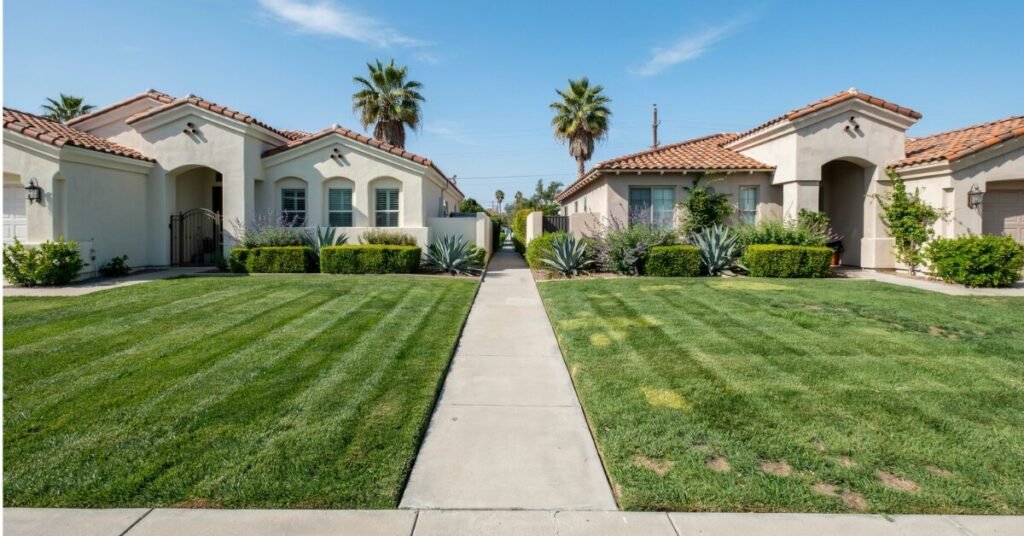
A Rancho Del Rey homeowner switched from weekly to biweekly lawn service in May to save money. His company charged $70 per biweekly visit instead of $50 weekly. He expected to cut costs. Instead, his Bermuda grass reached 5 inches between cuts. His HOA sent a violation notice in July. The emergency mowing visit cost $150. His annual “savings” cost him $200 more than weekly service would have.
This happens constantly in Chula Vista. The biweekly vs weekly decision looks simple. It isn’t. Not once you understand how Bermuda grass behaves in Southern California summer heat — and what HOAs in Eastlake, Otay Ranch, and Rancho Del Rey actually enforce.
Here is the honest answer. Weekly service is almost always right from April through October. Biweekly lawn service Chula Vista winters — November through March — is smart and saves real money. Biweekly lawn service Chula Vista homeowners use in winter — November through March — is smart, practical, and saves real money without any quality trade-off.
The key is knowing which months belong to which schedule — and that is exactly what makes biweekly lawn service Chula Vista homeowners choose the right call in winter.
The Fact Most Homeowners Get Backwards
Biweekly service costs more per visit than weekly service. Not less.
Most homeowners assume the opposite. They think longer intervals mean lower cost per visit. That is not how lawn care pricing works.
Here is why: when your lawn goes 14 days without cutting in Chula Vista’s summer heat, Bermuda grass grows significantly beyond the safe cutting threshold. The crew needs more time on your property. Often they need two passes — one to knock down height, one to finish cleanly. That extra labor drives the per-visit rate up, not down.
| Service Frequency | Per Visit (medium yard) | Monthly Cost | Annual Cost |
|---|---|---|---|
| Weekly (52 visits/year) | $45–$65 | $180–$260 | $2,340–$3,380 |
| Biweekly (26 visits/year) | $65–$80 | $130–$160 | $1,690–$2,080 |
| Hybrid (weekly Apr–Oct, biweekly Nov–Mar) | Mixed | $165–$235 avg | $1,980–$2,820 |
Monthly cost is lower with biweekly. Annual cost is lower with biweekly. But you’re getting half the visits — and in summer, those missing visits matter enormously for turf health and HOA compliance.
The biweekly lawn service Chula Vista hybrid schedule wins on every metric: cost, quality, and HOA compliance.
Why Biweekly Lawn Service Chula Vista Summers Is the Wrong Choice
Weekly mowing is the gold standard for most grass types, especially during the active growing season. In Chula Vista, that active season is longer than most guides assume.
Bermuda grass grows 1–2 inches per week from April through October in inland Chula Vista neighborhoods. In Eastlake and Otay Ranch — both in USDA Zone 10b — growth begins in March and continues into November. That is a 9-month active season.
During this season, biweekly lawn service Chula Vista creates three specific problems:
Problem 1: The One-Third Rule Violation
Healthy mowing never removes more than one-third of blade height at once. This is not a guideline. It is the threshold above which mowing causes measurable turf stress.
Bermuda at 1.5 inches (standard height) grows to 4–5 inches in 14 days during July. Cutting it from 4.5 inches back to 1.5 inches removes two-thirds of the blade. That is twice the safe threshold. The grass goes into stress. Color dulls. Density thins. Recovery takes 1–2 weeks — by which time the next biweekly cut is due.
Problem 2: The Scalping Cycle
One-third rule violations set up a recurring scalping cycle. Each biweekly cut stresses the turf. Stressed turf grows unevenly. Uneven turf gets cut unevenly on the next visit. Within 4–6 weeks of starting biweekly service on an active Bermuda lawn, the surface shows alternating thin and thick patches. This is not reversible without restarting a proper weekly program.
Problem 3: Weed Invasion
Dense, regularly cut Bermuda turf naturally suppresses weed germination by blocking sunlight at soil level. Stressed, thinning turf from scalping cycles creates the bare patches where crabgrass, spotted spurge, and nutsedge establish. Biweekly service can lead to inconsistent results and a lawn that struggles to stay healthy. For Chula Vista lawns, that struggle is visible by mid-summer.
HOA Enforcement Makes Weekly Mandatory in Most Planned Communities
This is the factor the Rancho Del Rey homeowner didn’t account for before switching schedules.
Chula Vista’s planned communities — Eastlake Greens, Eastlake Trails, Otay Ranch, Rancho Del Rey, and Terra Nova — enforce maximum grass height standards through HOA management. Most require lawns to stay at or below 4–5 inches. Some enforce stricter standards.
Bermuda grass in Chula Vista summer reaches 4 inches in 10–12 days without mowing. Not 14 days. 10–12 days. That means biweekly lawn service Chula Vista planned community homeowners use will frequently push lawns above the HOA threshold before the next visit arrives.
Here is the enforcement math. Your HOA inspects on a rotating 3-week cycle. Your biweekly cut was 11 days ago. Your lawn is likely at 3.5–4.5 inches on inspection day. That is borderline or in violation — depending on your sub-association’s specific standard.
| Planned Community | Typical Max Height | Biweekly Risk Level (Summer) | Recommendation |
|---|---|---|---|
| Eastlake Greens (II) | ~4 inches | High — active enforcement cycle | Weekly May–October |
| Eastlake III | ~4 inches | High — Walters Management enforces | Weekly May–October |
| Otay Ranch Villages 1–12 | 4–5 inches | Moderate-High | Weekly June–September |
| Rancho Del Rey | ~4–5 inches | Moderate | Weekly June–September |
| Terra Nova | ~5 inches | Moderate | Weekly or biweekly depending on growth rate |
Weekly service from May through October is not optional in Eastlake — it is the minimum schedule that keeps Bermuda HOA-compliant. Companies that offer biweekly lawn service Chula Vista HOA communities during peak summer are setting their customers up for violation notices.
Already received an HOA violation? Our emergency lawn care service handles same-week Eastlake and Otay Ranch response with HOA documentation on completion.
When Biweekly Lawn Service Actually Makes Sense in Chula Vista
Weekly service is not always the answer. There are legitimate scenarios where biweekly lawn service Chula Vista homeowners choose delivers excellent results.
| Scenario | Biweekly OK? | Why |
|---|---|---|
| Bermuda lawn, November–March | ✅ Yes | Dormancy — growth stops, weekly mowing unnecessary |
| Tall fescue, November–March | ✅ Yes | Fescue grows slowly in Chula Vista winters |
| Shaded lot with slow Bermuda growth | ✅ Yes | Shade limits growth rate significantly |
| Vacation or rental property | ✅ Yes | Appearance maintenance only — not performance optimization |
| Zoysia or buffalo grass lawn | ✅ Yes | Both grow significantly slower than Bermuda |
| Bermuda lawn, April–October, HOA community | ❌ No | Growth rate + HOA threshold = violation risk |
| Bermuda lawn, April–October, no HOA | ⚠️ Maybe | Only if you monitor height weekly and adjust |
| Tall fescue, June–August | ❌ No | Heat stress + growth creates scalping risk |
The clearest legitimate use case: biweekly lawn service Chula Vista homeowners with Bermuda lawns during the November through March dormancy period. Dormant Bermuda is straw-brown and grows almost nothing. Weekly visits during this period cost money for minimal work.
Most quality Chula Vista lawn companies offer a seasonal adjustment: weekly from April or May through October, biweekly from November through March. This is the hybrid schedule — and it is the right answer for most homeowners.
The Hybrid Schedule: Best of Both for Chula Vista Lawns
The Rancho Del Rey homeowner’s mistake wasn’t switching to biweekly. It was switching in May rather than November.
The hybrid approach splits the year by Bermuda’s growth behavior:
April or May through October: Weekly service
- Bermuda in active growth — 1–2 inches per week
- HOA compliance window requires consistent height management
- Weekly prevents scalping cycle and weed invasion
- 4 AM watering day before mowing day keeps turf conditions optimal
November through March: Biweekly service
- Bermuda dormant — minimal growth
- HOA enforcement typically less aggressive in winter
- Biweekly maintains appearance without over-servicing dormant turf
- Cost savings: approximately $100–$160 per month during off-season
Annual cost comparison — hybrid vs. pure weekly:
| Schedule | Annual Visits | Annual Cost (medium yard) | Quality Outcome |
|---|---|---|---|
| Pure weekly (52 visits) | 52 | $2,340–$3,380 | Excellent year-round |
| Pure biweekly (26 visits) | 26 | $1,690–$2,080 | Poor May–Oct, fine Nov–Mar |
| Hybrid (30 weekly + 10 biweekly) | 40 | $1,980–$2,520 | Excellent May–Oct, good Nov–Mar |
The hybrid schedule saves $360–$860 per year compared to pure weekly while delivering identical quality during the months that matter. It outperforms pure biweekly dramatically from May through October.
Ask your lawn care company specifically whether they offer seasonal frequency adjustment. Many do but won’t mention it unless asked.
We offer hybrid scheduling as standard for all Chula Vista customers. Weekly service activates in April and shifts to biweekly in November automatically — no calls needed. See our lawn care services for full schedule options.
Grass Type Determines the Right Answer
Your grass type is the deciding factor — even more than the season.
| Grass Type | Active Season Schedule | Dormant Season Schedule | Biweekly Summer? |
|---|---|---|---|
| Bermuda (standard) | Weekly Apr–Oct | Biweekly Nov–Mar | ❌ No |
| Bermuda (shaded lot) | Every 10 days | Monthly | ⚠️ Monitor only |
| Tall fescue | Weekly Sep–May | Every 10 days Jun–Aug | ❌ No (heat stress risk) |
| Zoysia | Every 10–14 days | Monthly | ✅ Yes |
| Buffalo grass | Every 10–14 days | Monthly | ✅ Yes |
Bermuda is the dominant grass type in Chula Vista’s planned communities. For Bermuda homeowners, the summer schedule is non-negotiable: weekly from the moment active growth begins.
Tall fescue behaves counterintuitively. It grows fastest in cool weather (fall and spring) and slows dramatically in heat. Fescue in Chula Vista summer sun shows heat stress already. Biweekly cutting during June through August adds scalping stress on top of that. Cutting stressed fescue too aggressively extends recovery time. Weekly or every-10-day service during summer keeps fescue at appropriate height without the scalping stress.
Not sure what grass type you have? Our lawn care team identifies grass type at first visit and sets the correct schedule from day one.
The Real Monthly Cost Comparison for Chula Vista
Biweekly lawn service Chula Vista homeowners often choose to save money. Here is what the monthly numbers actually look like with 2026 pricing:
Summer months (May–October) — medium yard:
| Schedule | Visits | Per Visit | Monthly Cost |
|---|---|---|---|
| Weekly | 4 | $50 | $200 |
| Biweekly | 2 | $70 | $140 |
| Monthly savings biweekly | — | — | $60 saved |
During summer, biweekly lawn service Chula Vista saves $60 per month on paper. But if that schedule triggers one HOA violation, the emergency service visit to resolve it costs $150. That eliminates 2.5 months of biweekly savings in a single event.
Winter months (November–March) — medium yard:
| Schedule | Visits | Per Visit | Monthly Cost |
|---|---|---|---|
| Weekly | 4 | $50 | $200 |
| Biweekly | 2 | $60 | $120 |
| Monthly savings biweekly | — | — | $80 saved |
During winter, biweekly saves $80 per month — and there is no quality or compliance downside on dormant Bermuda. Over 5 winter months, that is $400 in savings with zero risk.
This is why the hybrid schedule is the rational choice. Save money where it costs nothing (winter). Spend appropriately where it matters (summer). The Rancho Del Rey homeowner learned this the hard way. You don’t have to.
Questions to Ask Before Choosing a Service Frequency
Before committing to any lawn service schedule in Chula Vista, ask these four questions:
- [ ] What grass type do I have?
- Bermuda, fescue, or other? The schedule differs significantly.
- [ ] What are my HOA height requirements?
- Check your sub-association CC&Rs — not general HOA guidance.
- [ ] Does the company offer seasonal frequency adjustment?
- This is standard at quality companies and should be offered, not hidden.
- [ ] What is the biweekly premium per visit?
- If they charge the same per-visit rate for biweekly as weekly, ask why — crews need more time on biweekly cuts and the pricing should reflect that.
The right lawn care company gives clear answers to all four. Companies that push biweekly lawn service Chula Vista year-round — regardless of grass type or HOA requirements — are optimizing for route efficiency, not your lawn’s health.
Our lawn care pricing page shows full current 2026 rates for both weekly and biweekly schedules with no hidden adjustments.
FAQ: Biweekly vs Weekly Lawn Service in Chula Vista
Is biweekly lawn service cheaper than weekly in Chula Vista?
Monthly cost is lower — but per-visit cost is 40–50% higher for biweekly. A yard costing $50 per weekly visit typically costs $65–$75 biweekly. Over a full summer, biweekly saves around $60 per month. But biweekly during peak Bermuda season creates HOA violation risk and turf quality problems that cost more to fix than the savings.
Can I use biweekly lawn service in summer if I don’t have an HOA?
Technically yes — but expect visible quality decline on Bermuda lawns. Without HOA enforcement, scalping damage and weed invasion from biweekly summer cuts are the main risks. If your lawn is primarily used for appearance rather than active use, you can monitor it weekly yourself and supplement with extra cuts when needed.
What is the hybrid lawn service schedule and how does it work?
Weekly service from April or May through October — when Bermuda grows fastest and HOA enforcement is active. Biweekly service from November through March — when Bermuda is dormant and growth stops. This hybrid delivers full quality during the months that matter and saves $400+ annually during the months when weekly service provides no additional benefit.
Does biweekly service work for tall fescue in Chula Vista?
In winter (November through March), yes. In summer (June through August), no — fescue already shows heat stress in Chula Vista temperatures, and biweekly cutting adds scalping stress to heat stress. Fescue during summer should be cut every 7–10 days to maintain height without over-removing blade.
Why does biweekly cost more per visit than weekly?
Longer intervals mean more grass to cut. A Bermuda lawn going 14 days in summer heat reaches 4–5 inches. Cutting it back to 1.5 inches requires more passes, more time, and sometimes two separate cuts. That labor cost is reflected in the biweekly premium. A $50/week yard at $65–$70 biweekly is common in Chula Vista’s 2026 market.
How do I know if my Chula Vista lawn needs weekly or biweekly service?
Check grass type first: Bermuda in active growth needs weekly. Then check HOA requirements: most planned communities require lawns below 4–5 inches, which Bermuda exceeds in 10–12 days during summer. If both apply — Bermuda grass plus HOA community — weekly service May through October is not optional. See our guide on choosing the best lawn care company Chula Vista for more on evaluating service agreements.
Which Chula Vista neighborhoods benefit most from the hybrid schedule?
All of them. But the savings are highest in neighborhoods with significant Bermuda lawns and distinct seasonal temperature swings: Eastlake, Otay Ranch, and Bonita homeowners see the clearest benefit from switching to biweekly in November.
What happens if I start biweekly in summer and switch back to weekly?
Expect a 2–4 week recovery period. Bermuda that has been scalped through biweekly summer cuts grows unevenly. The first few weekly cuts will need to manage height variation across the lawn. Recovery is faster with a light fertilizer application and consistent watering. Our weed control service prevents opportunistic weeds from filling in during the transition.
The Right Answer for Your Chula Vista Lawn
Biweekly lawn service Chula Vista homeowners use intelligently — in winter, on slow-growing grass types, or on properties without HOA enforcement — is a legitimate cost-saving choice. It is not the wrong answer. It is just the wrong answer in summer, on Bermuda grass, in planned communities.
The Rancho Del Rey homeowner made three mistakes simultaneously. He switched to biweekly in May — not November. He had Bermuda grass — not fescue. And he was in an HOA community — not an unregulated property. Any one of those three conditions alone would have required weekly service. All three together guaranteed the violation notice.
The biweekly lawn service Chula Vista hybrid schedule costs $1,980–$2,520 per year for a medium yard. Pure biweekly costs $1,690–$2,080. The difference is $300–$440 annually. That gap pays for itself with a single avoided HOA emergency service call.
Choose your schedule based on your grass type, your HOA requirements, and the month of the year — not just the monthly cost. Those three variables give you the right answer every time.
What grass type do you have — and are you in an HOA community?
Serving Chula Vista homeowners across Eastlake, Otay Ranch, Bonita, Rancho Del Rey, and all neighborhoods. Hybrid weekly/biweekly scheduling available. CSLB licensed. Month-to-month agreements.