

It started with one patch near the sidewalk. Then another by the back fence. Within three weeks of May heat in Chula Vista, what was a clean green yard looked like something had scorched half of it overnight. Sound familiar?
Here’s the thing — brown grass in Chula Vista doesn’t have one cause. It has seven. And the fix for one will make another dramatically worse. Watering more to fight what looks like drought stress? If the real problem is a fungal disease spreading underground, you just turned a frustrating situation into a full lawn replacement.
I’ve talked to homeowners in Eastlake who spent three months fighting brown patches with the wrong treatment because they assumed summer heat was the culprit. It wasn’t. It was a sprinkler coverage gap — two zones hadn’t fired properly in over a year. The lawn told them. Nobody listened.
This guide breaks down every reason Chula Vista lawns turn brown: Bermuda dormancy, drought stress, invisible grubs, overwatering you didn’t realize you were doing, and six other causes that most homeowners never consider. By the end of this, you’ll know exactly what’s happening to your lawn and what to do about it this week — not next season.
What You’ll Learn (and What This Guide Won’t Pretend)
Chula Vista sits in Sunset Climate Zone 24 — warm, semi-arid, and brutally unforgiving to lawns that aren’t getting exactly what they need. We get the marine layer rolling in from the bay each morning, intense afternoon sun, and summer highs that regularly push past 95°F in inland neighborhoods like Otay Ranch and Eastlake. That combination puts unusual stress on both warm-season grasses like Bermuda and cool-season options like tall fescue.
In this guide, you’ll find the seven most common causes of brown grass in Chula Vista, ranked by how often they actually occur. You’ll get the 60-second screwdriver test that tells you whether drought is your problem right now. You’ll understand the difference between dead grass and dormant grass — a distinction that saves people from tearing up thousands of dollars of perfectly healthy lawn every single year. And you’ll get a clear signal for when professional lawn care in Chula Vista is actually the smarter call than another weekend of guessing.
What this guide won’t do: promise you a lush lawn on minimal effort. Chula Vista’s summer heat is real, water conservation is a civic responsibility, and any guide that skips over those realities isn’t being straight with you. This one is.
Dead or Dormant? The First Question That Changes Everything
Before you diagnose anything, you need to answer one question: is your grass dead, or is it sleeping? The difference determines whether your next move is treatment or replacement — and getting this wrong is the most expensive mistake Chula Vista homeowners make.
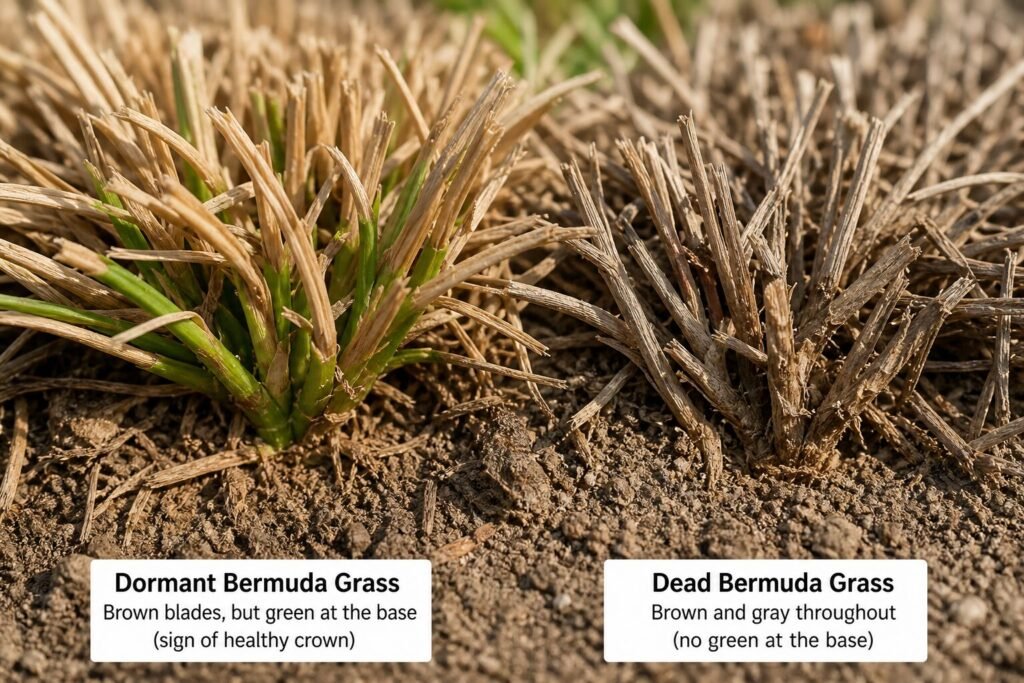
Bermuda grass — the most common warm-season turf in Southern California — goes fully dormant and turns straw-brown every winter, typically from December through March. This is completely normal. The grass isn’t dead. It’s conserving energy. Once soil temperatures climb back above 65°F in spring, it greens up on its own without you doing anything.
Tall fescue behaves differently. As a cool-season grass, it stays green through Chula Vista winters but can go into heat-induced stress or partial dormancy during extreme summer temperatures. If your fescue is browning in June or July during a heat wave, it’s probably stressed, not dead — but it needs water quickly to recover.
Here’s the test. Pull a handful of brown grass blades from the affected area. Examine the crown — the white base of each blade just above the soil. If the crown is still white, firm, and slightly flexible, the plant is alive. If the crown crumbles, is completely black, or snaps like a dry twig, that area is genuinely dead and will need reseeding or resodding.
A second test: water the brown area for three or four days and watch for any green response within a week. Dormant or drought-stressed grass responds quickly. Dead grass does nothing.
This distinction matters because the rest of this guide gives you treatments — and none of them work on dead turf. Know what you’re dealing with first.
Cause #1: Underwatering — The Most Common Culprit in Chula Vista Summers
Drought stress is responsible for the majority of brown lawns in Chula Vista from May through September. Most lawns need 1 to 1.5 inches of water per week during peak summer heat — and most homeowners are delivering far less than that without realizing it.
The problem usually isn’t that people aren’t watering. It’s that they’re watering for the wrong duration, at the wrong time, or with a sprinkler system that hasn’t been checked since they moved in. A sprinkler zone that runs for eight minutes sounds like it’s working. It may only be pushing half an inch of water into the soil — enough to wet the surface but not reach the root zone six inches down.
Drought stress has a distinct pattern. The lawn browns evenly across sun-exposed areas first. Grass blades curl inward lengthwise (this is the plant trying to reduce water loss). Step on it and the footprints don’t spring back — the blades stay flat because there’s no moisture pressure in the cells.
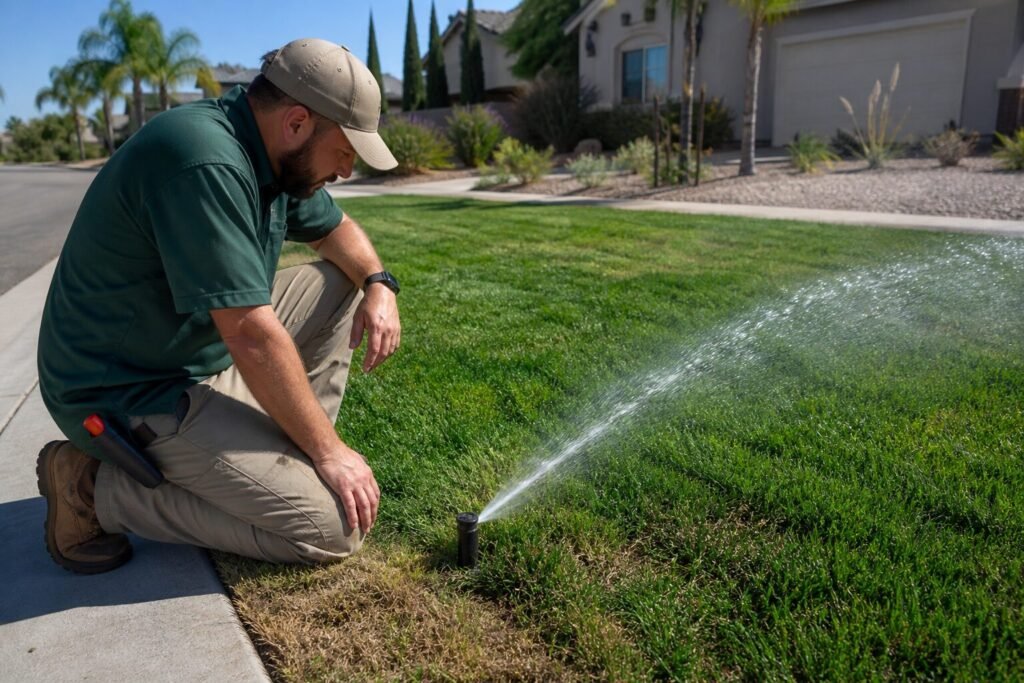
The screwdriver test is your fastest diagnostic: push a standard flathead screwdriver straight into the soil in a brown area. If it slides in to the handle with little resistance, soil moisture isn’t the problem — look at the other causes below. If it stops after two or three inches and won’t go further, the soil is bone dry. Drought stress is your answer. Adjust the watering schedule immediately and water deeply — 20 to 30 minutes per zone — for three consecutive days, then dial back to three times per week.
For Bermuda lawns in Chula Vista, the summer sweet spot is three deep waterings per week. Tall fescue lawns may need a fourth day during heat waves above 95°F. Water between 4 AM and 8 AM every time — watering at noon wastes up to 40% of your water to evaporation before it hits the root zone.
Cause #2: Overwatering (The One Nobody Suspects)
Overwatering turns grass brown almost as fast as underwatering — and the early symptoms look nearly identical. If you’re watering every day and your lawn still looks terrible, overwatering or drainage issues may be the reason.
When soil stays constantly saturated, the root system essentially drowns. Roots need oxygen. Waterlogged soil cuts off that oxygen supply, causing root rot that kills grass from the ground up while the surface looks fine. By the time you see widespread browning, the damage is already weeks old.
The visual tell for overwatering: brown grass that also has slimy or yellow patches between the blades, mushrooms appearing, or soil that feels spongy even during dry afternoons. Water pooling on the surface after your sprinklers run — or running off the lawn onto the sidewalk — means the soil is already saturated and can’t absorb more.
A secondary problem with overwatering in Chula Vista is fungal disease, which we’ll cover in a moment. Lawns that stay wet overnight are prime breeding grounds for Brown Patch and Dollar Spot, two of the most destructive fungal diseases in San Diego County.
If you suspect overwatering, reduce your irrigation frequency for two weeks and test the screwdriver in several spots. If the soil is consistently moist six inches down, cut back another watering day. For lawns with chronic drainage problems — common in Chula Vista neighborhoods with clay-heavy soil — our irrigation and sprinkler repair team can assess whether a drainage correction or system adjustment is the right call.
Cause #3: Sprinkler Coverage Gaps Nobody Notices Until Summer
Sprinkler systems in Chula Vista are set up once and forgotten for years. Heads shift, nozzles clog, and coverage patterns drift — leaving dry dead zones that appear every summer in the same spots.
This is one of the most frequently misdiagnosed causes of brown grass. The pattern is what gives it away: rectangular or circular brown patches that appear in the same location every year, often near edges, corners, or areas between two overlapping zones. The grass immediately around a sprinkler head looks fine. Twelve feet away, where the throw should reach but doesn’t, it’s brown.
Walk your sprinkler zones manually by running each zone for five minutes and watching where the water actually lands. You’ll often find a head that’s tilted, blocked by a plant that’s grown up around it, or has a clogged nozzle spraying a mist instead of the intended arc. Any of these create dry spots that show up as brown patches within a week of hot weather.
Common fixes include adjusting head positions, clearing debris from nozzles, and checking pressure — both too-low and too-high pressure causes uneven distribution. Systems that were installed five or more years ago frequently need nozzle upgrades to match current Chula Vista water pressure standards.
If a coverage audit reveals larger system issues — broken lines, faulty valves, or zones that won’t fire — that’s not a weekend fix for most homeowners. Our Chula Vista sprinkler repair specialists handle same-week diagnostics and repairs across the city.
Cause #4: Fungal Disease — Brown Patch and Dollar Spot
Fungal diseases are the most commonly misdiagnosed cause of brown grass in Chula Vista. They’re often mistaken for drought stress — but water won’t fix them. More watering makes them significantly worse.
Brown Patch (caused by Rhizoctonia Solani) is the primary summer fungal threat in our climate. It creates circular or irregular brown areas ranging from a few inches to several feet across, often with a slightly darker border. It spreads quickly during humid nights — and Chula Vista’s coastal marine layer creates exactly those conditions from May through October.
Dollar Spot presents differently: small, straw-colored spots roughly the size of a silver dollar, appearing in clusters. They can expand and merge into large dead areas if left untreated. This disease thrives during dry days followed by cool, moist nights — which describes Chula Vista’s summer pattern almost perfectly.
The key diagnostic difference between fungal disease and drought stress: water doesn’t fix fungal browning. If you’ve been watering consistently and the patches keep spreading rather than recovering, fungus is likely involved. Morning dew on the grass blades and visible white or gray mycelium (a cobweb-like coating on blades) at dawn are strong confirmation.
Treatment involves reducing evening watering — fungal spores spread through wet grass — and applying a registered fungicide labeled for your grass type. Persistent or large fungal outbreaks need professional assessment before they spread further. Our lawn care services include fungal disease diagnosis and targeted treatment programs.
Cause #5: Grubs, Chinch Bugs, and Other Lawn Pests
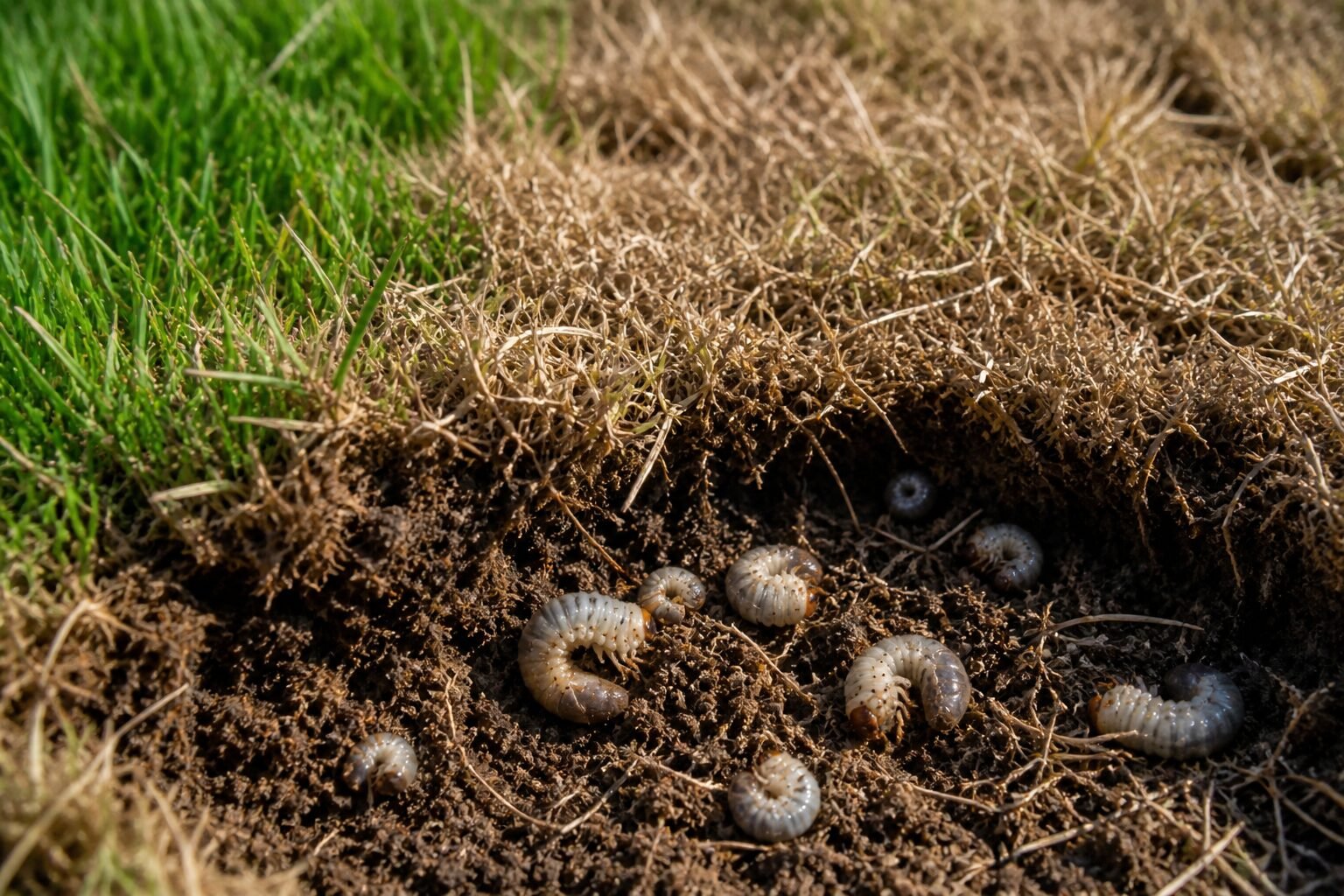
Lawn pests cause brown patches that look like drought stress from ten feet away — but behave completely differently up close. The grass lifts like a loose carpet because the roots feeding it have been eaten.
White grubs (larvae of beetles and June bugs) feed on grass roots from below. By the time you see browning, the roots in that area may already be gone. The diagnostic test: try to pull back the brown grass like a piece of sod. If it lifts easily with little root resistance, grubs are almost certainly underneath. You’ll often find the white, C-shaped larvae an inch or two below the surface.
Grub damage in Chula Vista typically peaks in late summer — July through September — as larvae grow larger and feed more aggressively. Skunks, raccoons, and birds digging up sections of your lawn is a reliable secondary sign.
Chinch bugs are less visible but equally destructive. They live in the thatch layer just above the soil surface and suck moisture out of grass blades, creating yellow-then-brown patches that spread outward from a central point. They’re most active in full-sun areas during the hottest part of summer — exactly the spots where drought stress also appears. The difference: chinch bug damage doesn’t respond to watering at all.
If you suspect pest damage, act quickly. A small infestation becomes a large one fast. Our weed control and lawn treatment services include pest diagnosis and targeted treatment — not broad applications that stress the rest of your lawn unnecessarily.
Cause #6: Compacted Soil and Thatch Buildup
Compacted soil is a slow killer. Your lawn looks like it’s struggling with everything — drought, heat, poor color — because compacted ground prevents water, oxygen, and nutrients from reaching the root zone at all.
Chula Vista’s clay-heavy soils compact more readily than sandy soils, especially in high-traffic areas: front yards, play areas, and along fences where the mower turns. When soil compacts, water runs off the surface rather than soaking in — you’ll see puddles after watering even on what looks like flat ground. Roots can’t penetrate deeper than three or four inches, making the lawn chronically stressed and brown during every summer heat event.
Thatch — the layer of dead organic material that accumulates between grass blades and the soil — compounds the problem when it builds up beyond half an inch. Bermuda grass in particular creates heavy thatch. A thick thatch layer acts like a sponge that holds water but releases it slowly, encouraging fungal disease while the actual soil underneath stays dry.
Core aeration is the fix for both. A core aerator pulls small plugs of soil out of the ground, breaking compaction and creating channels for water and air. For most Chula Vista lawns, aerating once per year in spring gives Bermuda time to recover. Tall fescue lawns benefit from fall aeration combined with overseeding.
Cause #7: Mowing Too Low — Scalping in Chula Vista Heat
Cutting grass too short in summer is one of the fastest ways to create brown patches. Scalped turf loses its ability to shade soil, retain moisture, and handle heat — and it browns within days of a hot spell.
The rule most Chula Vista homeowners don’t follow: never remove more than one-third of the grass blade in a single mowing. Bermuda grass handles a cutting height of one to two inches when actively growing but should be kept at the higher end during summer heat. Tall fescue needs to stay at three to four inches all summer — shorter than that and it burns fast.
Dull mower blades tear grass instead of cutting it cleanly. Those torn tips dry out and turn tan or brown, giving the whole lawn a burnt appearance even when the roots are healthy. If your lawn looks worse immediately after mowing, the blade is the problem. Sharpen or replace mower blades at least once per season — more often if you’re mowing weekly.
Raise your mowing height one notch starting in June and keep it there through September. It’s one of the simplest changes to make, and it reduces how often you need to water the lawn to maintain a healthy appearance.
Bermuda vs. Fescue: Why Your Grass Type Changes Every Answer
The single most important factor in diagnosing brown Chula Vista grass is knowing what type of grass you have. Bermuda and tall fescue respond completely differently to heat, drought, and disease — and the wrong treatment for the wrong grass type makes everything worse.
Most Chula Vista residential lawns are either Bermuda grass, tall fescue, or a combination of both. Here’s how to tell them apart: Bermuda has fine, narrow blades and spreads aggressively through stolons and rhizomes. It forms a dense, carpet-like turf and loves full sun. Tall fescue has broader, coarser blades, grows in clumps rather than spreading, and handles shade better.
Bermuda going brown in winter (December through March) is completely normal dormancy. Don’t water it heavily, don’t fertilize it, and absolutely don’t aerate it during dormancy. It wakes up on its own in spring. Bermuda browning in summer is drought stress, disease, or pests — not normal, and it needs diagnosis.
Tall fescue browning in summer is almost always water-related. Fescue uses about 30% more water than Bermuda during hot Chula Vista summers. If you have fescue and reduced watering in July, you’ll see it turn tan and thin within two weeks. It recovers well if you correct quickly. Fescue that stays stressed for more than three to four weeks develops weak root systems that won’t survive the rest of summer without professional intervention.
If you’re not sure which grass type you have, our team can assess it during a property walkthrough — and it changes every recommendation we make. See our service areas to find out if we cover your Chula Vista neighborhood.
How to Fix Brown Grass + When to Call a Professional
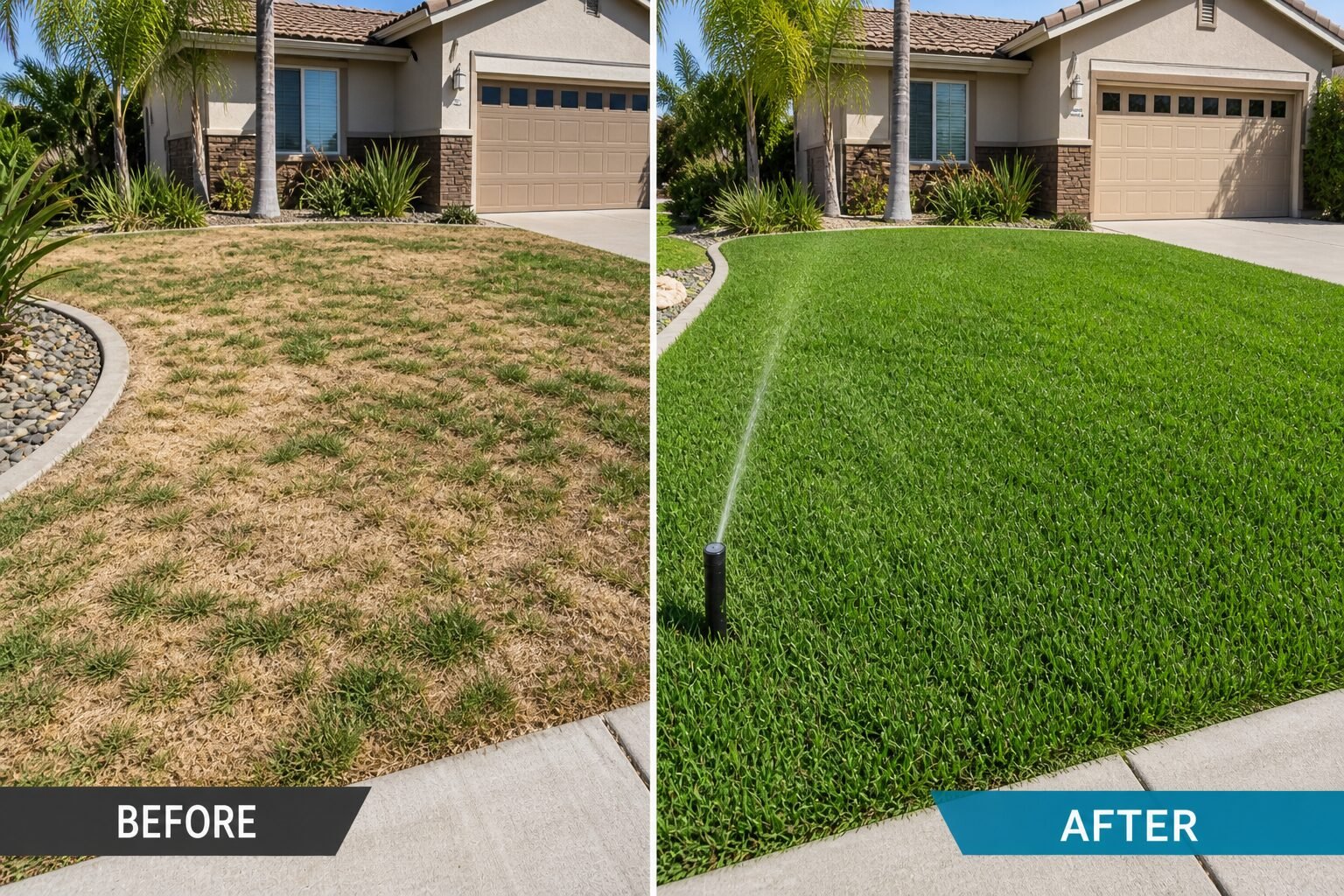
Brown grass that you’ve diagnosed correctly can often recover in two to three weeks with the right intervention. Brown grass that keeps getting worse despite your efforts is telling you the diagnosis was wrong — or the damage is deeper than surface treatment can reach.
Start with this recovery sequence. Run the screwdriver test in three separate brown areas. Check your sprinkler zones manually. Look at the brown patches: are they uniform across sun-exposed areas (drought), circular and spreading (disease), or localized with easy sod lift (pests)? Match your treatment to what you actually find — not what you assume.
For drought: water deeply for three consecutive days at 4 to 6 AM, then move to a consistent three-day-per-week schedule. Most drought-stressed Chula Vista lawns show visible improvement within seven to ten days.
For disease: stop all evening watering immediately, allow soil to dry between waterings, and apply a labeled fungicide for your grass type. Results take ten to fourteen days.
For pests: apply the appropriate insecticide (grub control, chinch bug spray) and water it in thoroughly. Recovery can take three to four weeks as the grass re-establishes roots.
Call a professional when the brown area covers more than 20% of the lawn and isn’t responding after two weeks of targeted treatment. When you find large-scale grub infestations that need curative products. When fungal disease keeps returning to the same spots year after year. And when any amount of watering adjustments fail to produce green recovery in drought-stressed grass — because at that point, compaction or a broken irrigation zone is the real underlying problem.
Our emergency lawn care service in Chula Vista handles urgent situations where lawns are deteriorating quickly and need same-week diagnosis. You can also see what lawn care costs in Chula Vista before committing to anything.
FAQ: Brown Grass in Chula Vista — Real Answers to Real Questions
Why is my Bermuda grass brown in winter but my neighbor’s lawn is still green?
Your neighbor likely has tall fescue, which stays green year-round in Chula Vista’s mild winters. Bermuda grass is a warm-season turf that goes dormant every December through March. It’s not dead — the root system is alive and the grass will green up in spring without you doing anything. If you want year-round green with Bermuda, you’d need to overseed with annual ryegrass each October.
Is brown grass dead or dormant? How do I know for sure?
Check the crown — the white base of each grass blade just above the soil. If it’s firm, pale, and slightly flexible, the plant is dormant or stressed but alive. If it’s black, crumbles, or snaps dry, that section is dead. The water test also helps: water the area for three days and watch for any green response within a week.
How often should I water my lawn in Chula Vista during summer?
Most Chula Vista lawns need 1 to 1.5 inches of water per week in summer. For Bermuda, that typically means three deep watering sessions per week at 20 to 30 minutes per zone. For tall fescue, add a fourth day during heat waves above 95°F. Water between 4 AM and 8 AM to prevent evaporation loss and fungal disease.
Why does my grass turn brown right after I mow?
Two likely causes: mowing too short (below 1.5 inches for Bermuda, below 3 inches for fescue) or dull mower blades that tear rather than cut grass cleanly. Torn tips brown within 24 to 48 hours. Sharpen blades every season and raise the cutting height one notch during June through September.
Can brown grass come back on its own?
Dormant grass (Bermuda in winter) comes back on its own every spring without intervention. Drought-stressed grass recovers in one to two weeks once watering is corrected. Pest or disease-damaged grass needs treatment before it recovers, and recovery takes three to four weeks. Truly dead grass won’t recover — it needs reseeding or resodding.
My sprinklers run every day but my grass is still brown. What’s wrong?
Daily watering with short run times creates shallow roots and often waterlogged surface soil. The underlying soil may be dry while the surface stays wet. Run each zone for 25 to 30 minutes, three times per week instead. Also check that sprinkler heads are covering all zones — walk the property while the system runs to spot any coverage gaps.
Could my HOA fine me for brown grass during summer heat?
California law — specifically the state’s drought protection statutes — generally protects homeowners from HOA fines for brown lawns during mandatory or recommended water restrictions. That said, HOA rules vary. Check your specific CC&Rs and document any water restriction notices from the city if you receive an HOA complaint about lawn appearance.
What’s brown patch disease and how do I know if I have it?
Brown patch is a fungal disease caused by Rhizoctonia Solani. It creates circular or irregular brown areas, often with a slightly darker ring around the perimeter. It spreads fastest during humid nights with temperatures above 70°F — exactly Chula Vista’s summer nighttime pattern near the coast. The giveaway versus drought stress: it doesn’t improve with more water, and it gets worse when watered in the evenings.
How much does it cost to fix a brown lawn in Chula Vista?
It depends heavily on the cause. A sprinkler head repair runs $75 to $150. A fungicide application for disease costs $80 to $180. Full lawn renovation with aeration, overseeding, and professional treatment typically ranges from $350 to $900 for a standard residential yard. Check our full Chula Vista lawn care pricing guide for current estimates.
Should I fertilize brown grass to help it recover?
No — not during a heat event or active stress period. High-nitrogen fertilizer pushes top growth that the root system can’t support when the lawn is already stressed. That creates more burning and browning. Wait until the grass has visibly greened up and the stress period has passed, then apply a slow-release fertilizer in the appropriate amount for your grass type.
Can grubs cause brown spots that look exactly like drought?
Yes, and this is the most dangerous misdiagnosis in Chula Vista lawns. The visual difference: drought stress causes even browning across sun-exposed areas, and the grass stays rooted in the soil. Grub damage creates patches where the grass lifts like a loose carpet with almost no root resistance. Birds digging into your lawn is another reliable sign of grubs feeding below.
When should I just resod instead of trying to fix brown grass?
If more than 40 to 50% of a lawn area is genuinely dead (not dormant), reseeding or resodding is more cost-effective than trying to repair it. If the same area browns out severely every summer for two or three years in a row, there’s an underlying structural problem — compaction, drainage, or irrigation — that surface treatment won’t solve. Our Chula Vista lawn care team can assess whether repair or renovation makes more financial sense for your specific situation.
The Bottom Line on Brown Grass in Chula Vista
Every brown lawn has a story. It started somewhere specific — a sprinkler head that drifted two inches off target, a thatch layer that quietly built up through three Bermuda growing seasons, a grub that got into the root zone in July and had four weeks of undisturbed feeding before anyone noticed.
The homeowners who keep their lawns looking right in Chula Vista summers aren’t doing anything magic. They run their sprinkler zones manually once a month. They check the soil with a screwdriver before adjusting the watering schedule. They know whether they have Bermuda or fescue and treat accordingly. Small, consistent habits prevent the catastrophic browning that costs three times as much to fix.
If you’re already staring at a lawn that’s more brown than green this spring, start with the screwdriver test today. That single diagnostic will either confirm drought stress and give you a fix you can start this morning — or tell you the problem runs deeper and it’s time to bring in a professional before the heat of June and July make it significantly worse.
Our team serves Chula Vista homeowners across Eastlake, Otay Ranch, Bonita, and every neighborhood in between. What’s the condition of your lawn right now — and how long has that brown patch been spreading?