Your dog does his business in the same corner of the backyard every morning. For the first few weeks after you moved in, you didn’t think much of it. Then one Tuesday you looked out the window and noticed a yellow patch the size of a dinner plate right where he always goes. Three weeks later it turned brown. Three weeks after that, you have seven dead circles spread across the back lawn and no idea which one to fix first.
Welcome to the most common — and most frustrating — lawn problem for dog-owning homeowners in Chula Vista.
Here’s the thing most guides won’t tell you: the standard repair advice written for Ohio or Georgia does not fully apply to a Chula Vista Bermuda or fescue lawn in May. The products are the same. The nitrogen chemistry is the same. But the timing, the watering instructions, and the grass behavior in a semi-arid 95°F Southern California summer are completely different. Rinse every urine spot the moment your dog goes? The standard advice. But you’re also on a city water schedule with restrictions from March through October. That conflict alone causes thousands of Chula Vista homeowners to fail at repair — not because they did the wrong thing, but because the guide they followed didn’t know what city they lived in.
This guide does. By the end, you’ll know exactly why dog urine kills grass, how to diagnose yellow versus dead spots, the step-by-step repair process for both Bermuda and tall fescue lawns, which products genuinely work versus which ones take your money, and how to prevent this from happening repeatedly without turning your backyard into a construction zone.
Why Dog Urine Kills Grass (And It’s Not What Most People Think)
Dog urine burns grass because of concentrated nitrogen, not acidity. This distinction matters because half the products sold for “urine pH correction” are solving the wrong problem entirely — and some of them are hard on your dog’s kidneys.
When your dog processes protein, the body breaks it down and filters the nitrogen waste through the kidneys into urine as urea. Urea converts to ammonia in the soil, then to ammonium — a form of nitrogen. Your lawn actually needs nitrogen. It’s in every fertilizer you buy. The problem is delivery: instead of a controlled, diluted release across your entire lawn, a large dog deposits a highly concentrated dose in a 12-inch circle. That’s the equivalent of pouring an entire bottle of liquid nitrogen fertilizer on one spot.
The result is nitrogen burn — the same effect you’d get from over-fertilizing too heavily in one area. The grass blades yellow, then brown, then die. The soil underneath becomes salty and chemically hostile to regrowth.
Female dogs cause three times more visible damage than males, and the reason is entirely anatomical. Female dogs squat low and release their entire bladder volume in one concentrated stream directly onto the grass. Male dogs lift a leg and spray — distributing smaller amounts across multiple surfaces, including fences, trees, and concrete. A large female Labrador or German Shepherd deposits enough nitrogen in one go to kill a patch of Bermuda grass in 48 hours during a Chula Vista summer.
Diet plays a role too. High-protein diets — which are nutritionally good for dogs — produce urine with higher nitrogen concentration. Dogs that drink more water have naturally more diluted urine and cause less visible damage. This is why the single most effective prevention tool (which we’ll cover) costs nothing.
Yellow vs. Brown Spots: Two Completely Different Repair Paths
Yellow urine spots and brown urine spots require different responses. Treating a yellow spot like a dead brown one wastes three weeks and potentially kills grass that could have recovered on its own.
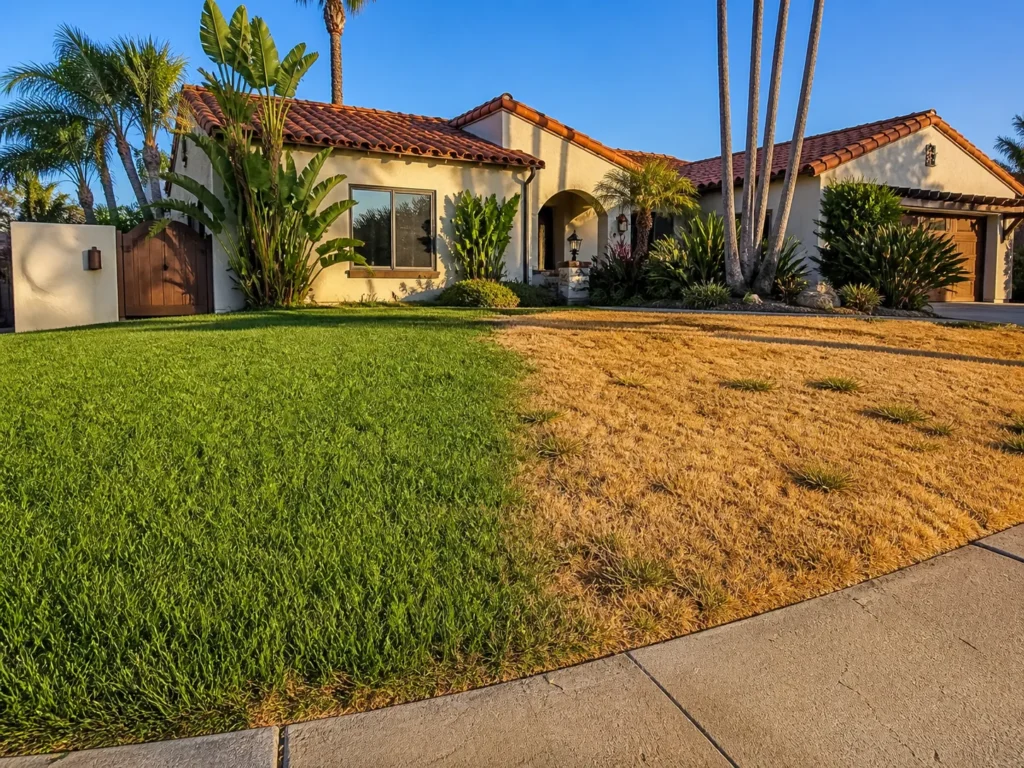
Yellow spots mean the grass is stressed and dying but not yet dead. The urine hit recently — usually within the past three to ten days — and the nitrogen burn is damaging the grass blades from the top down. The roots may still be viable. This is the stage where flushing with water can save the grass without any reseeding at all.
Brown spots mean the nitrogen concentration was high enough, or sat long enough, to kill the grass from the roots up. Brown grass that pulls out easily with no root resistance is dead. You cannot revive it with water or products. You need to remove it, treat the soil, and reseed or resod.
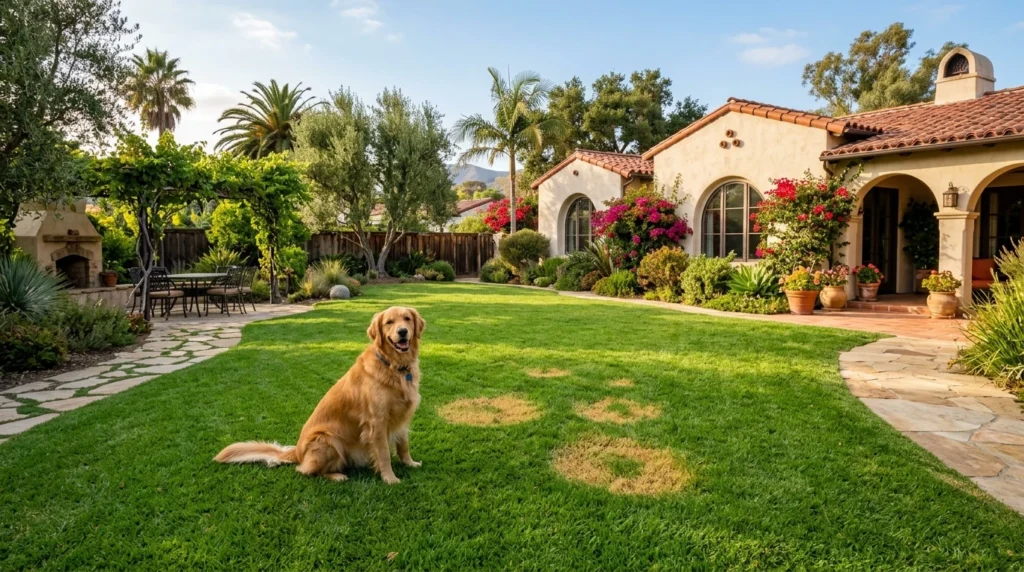
Here’s how to tell them apart definitively. Get on your knees and look at the center of the spot. Yellow spots have grass blades that are yellowing or tan but still attached to visible roots when you pull gently. The soil underneath smells faintly of ammonia. Brown spots have brittle, completely dead blades that come up easily — and a dark ring of unusually green, lush grass around the perimeter. That dark green ring is critical: it’s showing you exactly where the urine was diluted enough to fertilize rather than burn. It’s nature drawing a circle around the damage.
Dark green patches with no yellow or brown center are actually a sign your lawn is nitrogen-deficient overall. Dog urine hitting those areas acts as fertilizer rather than poison. This is common in older Chula Vista yards where lawns haven’t been fed properly in years.
The 60-Minute Flush: Your First Response After Your Dog Goes
The single most effective thing you can do for dog urine spots costs nothing and takes 60 seconds: flush the spot with water the moment you see your dog urinate. Done within 60 minutes, this prevents most visible damage entirely.
The science is straightforward. Diluting the nitrogen concentration before it reaches the root zone stops the burn before it starts. Studies from the University of California Agricultural Extension confirm that immediate watering of urine spots reduces visible grass damage by over 50% compared to areas left unflushed.
For Chula Vista homeowners, here’s the practical application: keep a hose bib accessible in the backyard, set the nozzle to a gentle shower (not a jet that compacts soil), and run water over the spot for 30 to 45 seconds. You don’t need to drench it — you need to dilute it. Two gallons of water over a 12-inch spot is enough.
The Chula Vista water restriction problem is real here. From March through October, the city recommends watering no more than two to three days per week. You cannot use your irrigation system to flush every urine spot your dog creates. What you can do is keep a separate 5-gallon watering can filled near the back door and manually flush spots as they occur. Hand watering of specific spots is not the same as running your irrigation system and does not conflict with conservation guidelines.
If you can’t flush within 60 minutes — you weren’t home, you didn’t see it happen — the damage is already progressing. Move to the yellow spot treatment below.
Step-by-Step Repair for Yellow Spots (Stressed But Not Dead)
Yellow spots that haven’t fully died can often recover without reseeding if you act within 10 days of visible yellowing. The goal is to flush nitrogen out of the root zone and give the grass a chance to recover naturally.
Step 1: Flush deeply.
Run water over the yellow spot for two to three full minutes — much longer than the preventive flush. You want to push the concentrated nitrogen and salts down below the root zone (six to eight inches deep). Use a hose set to a gentle rain pattern. Do this twice daily for three consecutive days.
Step 2: Stop all fertilizer applications nearby.
Adding nitrogen to an area already stressed by excess nitrogen makes it worse. Hold off fertilizing the surrounding lawn for at least four weeks.
Step 3: Raise your mowing height by one notch.
Taller grass shades the soil, reduces heat stress, and gives recovering roots less surface blade to support. For Bermuda, go from 1 inch to 1.5 inches. For tall fescue, go from 3 inches to 3.5 to 4 inches.
Step 4: Keep your dog off it.
This sounds obvious but it’s where most repairs fail. The dog will return to the exact same spot — dogs are creatures of habit and will seek their own scent. Block the area temporarily with a small wire garden fence or a potted plant. Even three weeks of re-exposure undoes all your work.
Step 5: Watch for two weeks.
Yellow spots with viable roots show visible new green growth from the crown within 10 to 14 days of flushing. Bermuda recovers faster than fescue due to its self-spreading stolons and rhizomes. If the spot stays yellow or turns brown after two weeks of treatment, the roots are gone and you need the dead spot repair process below.
Step-by-Step Repair for Brown Dead Spots: Bermuda Grass
Bermuda grass is the most forgiving turf for dog owners in Chula Vista. Its aggressive spreading via stolons and rhizomes means surrounding healthy Bermuda will naturally fill in small dead spots (under 6 inches) without reseeding — if the soil is treated first.
Small spots (under 6 inches diameter):
Step 1: Remove dead grass completely.
Rake out all dead material — don’t just cut it short. The dead crown blocks new growth from establishing. Get down to bare soil.
Step 2: Flush the soil aggressively.
Water the bare spot with two to three minutes of running water twice per day for four consecutive days. You’re pushing accumulated nitrogen salts below the root zone.
Step 3: Loosen the top inch of soil.
Use a hand cultivator or a garden fork to break up any compaction and create a seed bed. Chula Vista’s clay-heavy soils compact quickly, especially in high-traffic dog areas.
Step 4: Apply gypsum.
Gypsum (calcium sulfate) loosens compacted soil, improves drainage, and helps flush sodium salts from dog urine without affecting soil pH. Sprinkle at a rate of one pound per 10 square feet and water in. This is one product that genuinely earns its place in a Chula Vista dog-spot repair kit.
Step 5: Let surrounding Bermuda spread in.
If the dead patch is smaller than 6 inches, active Bermuda grass will naturally grow into it within three to six weeks during the warm growing season (April through October in San Diego County). Water the surrounding grass normally and you’ll see stolons creeping across the bare soil within two weeks.
Step 6: For larger spots (over 6 inches), reseed or resod.
Use Bermuda grass seed matched to your existing variety, or cut a small plug of sod from a non-visible area of your lawn and press it into the prepared soil. Keep moist — not wet — for 14 days until established.
Step-by-Step Repair for Brown Dead Spots: Tall Fescue
Tall fescue does not self-repair. It grows in clumps, not through spreading stolons. Every dead spot in a fescue lawn requires manual reseeding, and timing that reseeding for Chula Vista’s climate is the step most guides completely miss.
Tall fescue repairs follow the same soil preparation steps as Bermuda (remove dead grass, flush thoroughly, loosen soil, apply gypsum). The critical difference is what happens next.
Timing is everything for fescue reseeding in Chula Vista.
Fescue seed germinates best when soil temperatures are between 55°F and 70°F. In Chula Vista, that means two ideal windows: mid-September through November, and late February through mid-March. Seeding into summer heat above 80°F soil temperature produces poor germination and wastes seed.
If you’re repairing fescue spots in May, June, July, or August: do the soil treatment now, but hold off on seeding until September. Keep the bare area moist and block your dog from it. When September arrives, seed with a tall fescue blend matched to your existing grass type — common options for Southern California include Marathon varieties and similar heat-adapted cultivars.
Seed application:
Scratch seed into the loosened soil at the rate of 8 pounds per 1,000 square feet for bare spots. Cover lightly with peat moss or straw to retain moisture. Water twice daily until germination (10 to 14 days), then reduce to once daily until established at two inches of height.
The fescue reseeding commitment:
Many Chula Vista homeowners with tall fescue and active dogs fall into a cycle of small patch repairs every few months. If your dog has a favorite zone and you have fescue, the honest answer is that you’ll be reseeding that zone every fall as part of your annual lawn maintenance routine. Plan for it rather than fighting it.
The Chula Vista Problem Nobody’s Guide Mentions: Water Restrictions + Summer Heat
Every national guide tells you to immediately flush urine spots with water. But in Chula Vista during summer, you’re balancing water conservation requirements, irrigation restrictions, and 95°F heat that accelerates nitrogen burn simultaneously. Here’s how to manage all three.
The core conflict: Chula Vista’s best-practice watering schedule runs three days per week at most, and early morning hours only (4 to 8 AM). Your dog urinates throughout the day — sometimes at noon, sometimes in the afternoon. A urine spot sitting in 95°F afternoon heat without flushing for 18 hours does damage that takes three weeks to repair.
The solution is separating your irrigation system from your spot-flushing routine. Your irrigation system runs on schedule. Your spot-flush routine uses a separate hand watering source — a watering can kept filled near the back door, or a hose fitted with a shut-off nozzle attached to an outdoor spigot. Hand-flushing individual spots is not running your sprinkler system and doesn’t conflict with conservation guidelines or your irrigation schedule.
Summer heat compounds urine damage in a way that Chula Vista homeowners feel acutely. Nitrogen burns are significantly worse when soil temperatures exceed 85°F — which happens regularly in inland Chula Vista neighborhoods like Eastlake and Otay Ranch from June through September. The heat accelerates nitrogen conversion, reduces soil moisture, and stresses the grass simultaneously. A urine spot that might cause minor yellowing in a cooler climate creates a fully dead circle within 72 hours in a Chula Vista August.
The fix: Water your entire lawn the morning after any day your dog has been active outdoors in summer. Not a full irrigation cycle — just a brief five-minute run of the zone covering the dog’s area to dilute any overnight spots you missed. Done at 6 AM before the heat builds, this costs minimal water and prevents the compounding damage of heat-accelerated nitrogen burn.
Products That Actually Work (and Three That Don’t)
The dog urine lawn repair market is full of products that promise results and deliver confusion. Here’s an honest breakdown based on what the chemistry actually does — not what the packaging claims.
Products that work:
Gypsum (calcium sulfate, $8–$15 per 25 lb bag): Addresses the salt component of urine damage, loosens compacted clay soil common in Chula Vista, and helps flush sodium from the root zone. Use it. It works and it’s inexpensive.
Scotts EZ Seed Dog Spot Repair ($12–$18 for 2 lbs): A 3-in-1 mix of grass seed, mulch, and soil amendment with a salt neutralizer formula. Effective for small spot repairs on cool-season grasses. The salt neutralizer is the useful ingredient here — the grass seed germinates well if you apply it in the right temperature window. For Bermuda lawns, you don’t need this — use straight Bermuda seed instead.
Activated carbon soil treatment: Binds excess nitrogen in the soil, reducing its concentration. Works best applied immediately after visible yellowing, before the burn progresses to brown. Available at garden centers as a powder amendment.
Increased water intake for your dog: The most effective long-term intervention, costs nothing, and is vet-approved. More water = more diluted urine = less burn. Multiple water bowls, a pet fountain, or a small amount of water mixed into food all increase consumption.
Products that don’t work as advertised:
Dog urine pH supplements (tablets, biscuits, chews): Most of these target urine acidity, not nitrogen concentration. Since nitrogen — not acidity — causes grass damage, correcting pH doesn’t address the root problem. Some of these supplements can stress your dog’s kidneys with regular use. Always consult your vet before using.
Tomato juice or vinegar rinses: These are internet myths. Neither neutralizes soil nitrogen. They don’t help the lawn and vinegar actively harms grass.
“Urine-proof” grass seed with special coatings: No grass variety is immune to concentrated nitrogen burns. Any seed sold as fully urine-resistant is marketing language. What matters is grass self-repair ability (Bermuda wins on this in Chula Vista) and how quickly you flush after exposure.
How to Train Your Dog to Use One Spot (Without Spending a Fortune)
Designating a single potty zone is the single most impactful long-term strategy for dog owners in Chula Vista. One concentrated repair zone is infinitely easier to manage than seven random spots across your entire lawn.
Pick a spot in the least visible area of your yard. Ideally it’s a corner, along a fence, or partially screened from street view. Remove the grass in that zone entirely and replace it with pea gravel, decomposed granite, or coarse wood chips. These materials drain instantly, don’t burn, and are easy to rinse clean. A 4-foot by 4-foot designated zone handles most dogs comfortably.
The training itself is straightforward but requires two weeks of consistency. Walk your dog on a short leash to the designated zone every time you take them outside. When they urinate there, mark the moment with a verbal marker (“yes!” or a clicker) and immediately reward with a high-value treat. Do not allow free roaming until after they’ve used the zone. Dogs learn location habits quickly — most dogs reliably use a designated zone within 10 to 14 days of consistent positive reinforcement.
For dogs that already have deeply ingrained habits in specific lawn areas: remove the dead grass in their preferred spots, treat the soil, and use a commercial dog repellent spray (citrus-based, pet-safe) on the lawn areas you want to protect while the new zone is being established. The repellent smell redirects sniffing behavior. Combined with zone training, this breaks the old location habit within three to four weeks for most dogs.
Preventing Urine Burns Before They Start: Long-Term Lawn Strategy
Prevention costs a fraction of what repeated repairs cost. The three strategies below address the three causes of dog urine damage — nitrogen concentration, location habit, and grass vulnerability — simultaneously.
Hydration management: Increase your dog’s daily water intake by 20 to 30% through an automatic pet fountain, multiple bowls in different locations, or adding a tablespoon of water to their food. More water = more dilute urine. This alone reduces visible damage significantly in most dogs within two weeks. It requires no products, no lawn changes, and improves your dog’s overall kidney health.
Grass type selection for dog-heavy zones: If you’re reseeding or renovating any portion of your lawn, choose Bermuda grass for areas with high dog traffic in Chula Vista. Bermuda’s self-spreading growth pattern fills in damage faster than any other option in our climate. Tall fescue is more urine-tolerant in terms of initial damage, but it cannot self-repair — making it a worse long-term choice for active-dog yards.
Regular aeration of high-traffic dog zones: Chula Vista’s clay soils compact under repeated dog foot traffic, reducing drainage and increasing nitrogen concentration near the surface. Aerating high-traffic dog areas once per year in spring breaks compaction, improves water penetration, and helps flush accumulated salts deeper into the soil profile. Combine aeration with a gypsum application for maximum salt-flushing effect.
Our lawn care services include annual aeration programs tailored for Chula Vista’s clay-heavy soils — particularly useful for households with multiple large dogs or concentrated outdoor activity zones.
When Dog Urine Damage Needs Professional Repair
Most dog urine spots are DIY-fixable in two to six weeks. A few situations call for professional assessment — and catching them early costs significantly less than waiting until the damage is extensive.
Call a lawn care professional when:
You have more than 15 to 20 dead spots across the lawn and the pattern keeps expanding despite your repairs. This volume suggests either unusually high nitrogen concentration in your dog’s urine (a vet conversation worth having) or underlying soil issues — compaction, poor drainage, or pH imbalance — that are magnifying normal urine damage.
You’ve done the repair process correctly twice and the same spots keep dying. This indicates the soil in those zones has accumulated nitrogen and salts beyond what flushing alone can correct. Professional soil amendment and pH correction are needed before reseeding produces lasting results.
Your entire dog zone needs renovation — removing existing grass, amending soil, installing gravel or decomposed granite, and establishing the designated potty area properly. This is a half-day project for a professional that most homeowners underestimate as a weekend job.
The lawn has additional problems beyond urine spots. Brown patches that look like urine damage but don’t match the locations your dog uses could be fungal disease, compaction damage, or sprinkler coverage gaps. Our guide on why grass turns brown in Chula Vista covers how to tell the difference before spending money on the wrong treatment.
For emergency situations where large areas have died quickly — particularly relevant if you’ve recently adopted a larger breed or had house guests with dogs — our emergency lawn care service in Chula Vista provides same-week assessment and repair planning. You can also check what professional lawn repair costs in Chula Vista before scheduling anything.
We serve dog-owning homeowners across Eastlake, Otay Ranch, and the broader Chula Vista area — neighborhoods where active-dog households and HOA lawn standards regularly create exactly this challenge.
FAQ: Dog Urine Spots on Lawn — Chula Vista Edition
Why does dog urine kill grass but regular fertilizer doesn’t?
The problem isn’t the nitrogen itself — it’s the delivery concentration. A bag of lawn fertilizer releases nitrogen slowly and diluted across your entire lawn. A large dog deposits the equivalent of several times the recommended fertilizer dose in a 12-inch circle all at once. That concentrated hit overwhelms the grass’s ability to absorb it, causing chemical burn. The chemistry is identical to over-fertilizing a single spot by 500%.
Does female dog urine damage lawns more than male dog urine?
Yes — significantly. Female dogs squat and release their full bladder volume in one concentrated stream directly onto the grass. Male dogs mark with smaller amounts spread across multiple surfaces including fences, trees, and hardscape. The same dog, same nitrogen content in urine, but the delivery pattern means females cause three to five times more visible lawn damage per visit.
How long does it take to repair dog urine spots in Chula Vista?
Yellow spots (stressed, not dead) can recover in 10 to 14 days with consistent flushing and rest. Brown dead spots take three to six weeks for full visible repair — two weeks of soil treatment and flushing, then two to four weeks for new grass to establish. Bermuda grass repairs faster than tall fescue due to its self-spreading growth.
Can I water my lawn more to prevent dog spots if I’m on water restrictions?
The water restriction conflict is real in Chula Vista. The workaround: keep a separate watering can near your back door specifically for spot-flushing. Hand-flushing individual spots after your dog goes is not the same as running your irrigation system and doesn’t conflict with conservation guidelines. Flush spots within 60 minutes of urination — that’s when dilution is most effective.
What grass is best for dogs in Southern California?
For Chula Vista’s climate, Bermuda grass is the top choice for active-dog yards. Its self-spreading stolons and rhizomes naturally fill in urine damage and high-traffic wear faster than any other turf type. Tall fescue handles individual urine events slightly better in terms of initial burn resistance, but it cannot self-repair — requiring manual reseeding every time a spot dies. For a large dog in a Chula Vista yard, Bermuda wins.
Do dog urine supplements actually work?
Most don’t — at least not for your lawn. The majority of supplements target urine pH (acidity), but nitrogen concentration — not pH — is what burns grass. Products that claim to make urine “lawn safe” by altering pH are solving the wrong problem. The only proven intervention is increased water intake, which dilutes urine nitrogen naturally. Always consult your vet before changing your dog’s diet or adding any supplement.
Is gypsum safe to use where my dog plays?
Yes. Agricultural gypsum (calcium sulfate) is non-toxic to pets, people, and beneficial soil organisms. It doesn’t alter soil pH significantly (unlike lime), it loosens compacted clay, and it helps flush sodium salts from urine damage. At repair application rates of 1 pound per 10 square feet, it’s safe for immediate pet access once it’s been watered in.
Why do I have a dark green ring around my brown spots?
The dark green ring is the urine’s fertilizing effect at the diluted outer edge. At the center, urine concentration was high enough to burn. At the perimeter, it diluted naturally and acted like a low-dose nitrogen fertilizer. This ring pattern is actually a reliable diagnostic indicator of dog urine damage versus other causes like fungal disease or grubs, which produce different visual patterns.
Can I reseed in summer to fix dog spots in Chula Vista?
For Bermuda lawns: yes, summer is actually the best time to reseed or plug Bermuda — it loves heat and germinates fast when soil temperatures are above 65°F. For tall fescue: no. Fescue reseeded in Chula Vista summer heat fails to germinate or dies within weeks of establishment. Wait until mid-September through November for fescue repairs. Treat and protect the bare soil now; seed in fall.
My dog keeps returning to repaired spots and re-burning them. How do I break this habit?
Dogs return to spots they can smell, even after you’ve removed all visible dead grass. The nitrogen and ammonia compounds in urine leave scent markers in soil that persist for weeks. After repairing a spot, apply a citrus-based dog repellent spray (pet-safe) to the repaired area for two to three weeks. This disrupts the scent trail while new grass establishes. Simultaneously, start training your dog to a designated gravel potty zone in a less visible corner of the yard.
How much does professional dog urine lawn repair cost in Chula Vista?
Costs vary by damage extent. Basic soil amendment and spot reseeding runs $150 to $350 for a standard residential yard with 10 to 20 damaged spots. Full renovation of a heavily damaged dog zone — removing existing turf, soil treatment, installing a gravel potty area, and reseeding surrounding lawn — typically runs $400 to $900 depending on square footage. See our Chula Vista lawn care pricing page for current estimates.
What does professional lawn care actually do for dog spots that I can’t do myself?
The main difference is soil analysis. A professional assesses whether accumulated nitrogen and salt levels in repeatedly damaged zones have reached the point where DIY flushing alone won’t correct the problem. Some zones need pH amendment, soil replacement, or deep aeration before reseeding produces lasting results. Professionals also handle the volume — repairing 25 spots in a single visit is a different undertaking than the two or three you can realistically manage on a Saturday. Our professional lawn care team serves all Chula Vista neighborhoods.
The Truth About Dogs and Lawns in Chula Vista
Here’s what the internet won’t tell you: you can have a beautiful Bermuda lawn and an active large dog in Chula Vista — but you can’t have both without a system. The dog wins every time you leave the management to chance.
The system isn’t complicated. It’s a watering can near the back door. It’s a designated gravel corner trained with two weeks of consistency and treats. It’s understanding that your Bermuda lawn, unlike tall fescue, will naturally heal most damage if you give it soil treatment and a break from re-exposure. It’s knowing that the dark green ring around a dead spot is just nitrogen doing what nitrogen does — fertilizing at lower concentrations.
The homeowners who call us for professional help most often waited three or four months past the point where a simple flush and reseed would have worked. Brown spot repair is never an emergency — until six brown spots become sixteen and the whole back lawn needs renovation. Start with the watering can. Start this week.
What breed is your dog, and how long have the spots been there? Drop your situation in the comments — the answer changes significantly based on the grass type you have and how long the damage has been progressing.