Drought Tolerant Landscaping in Chula Vista:
Full 2026 Guide
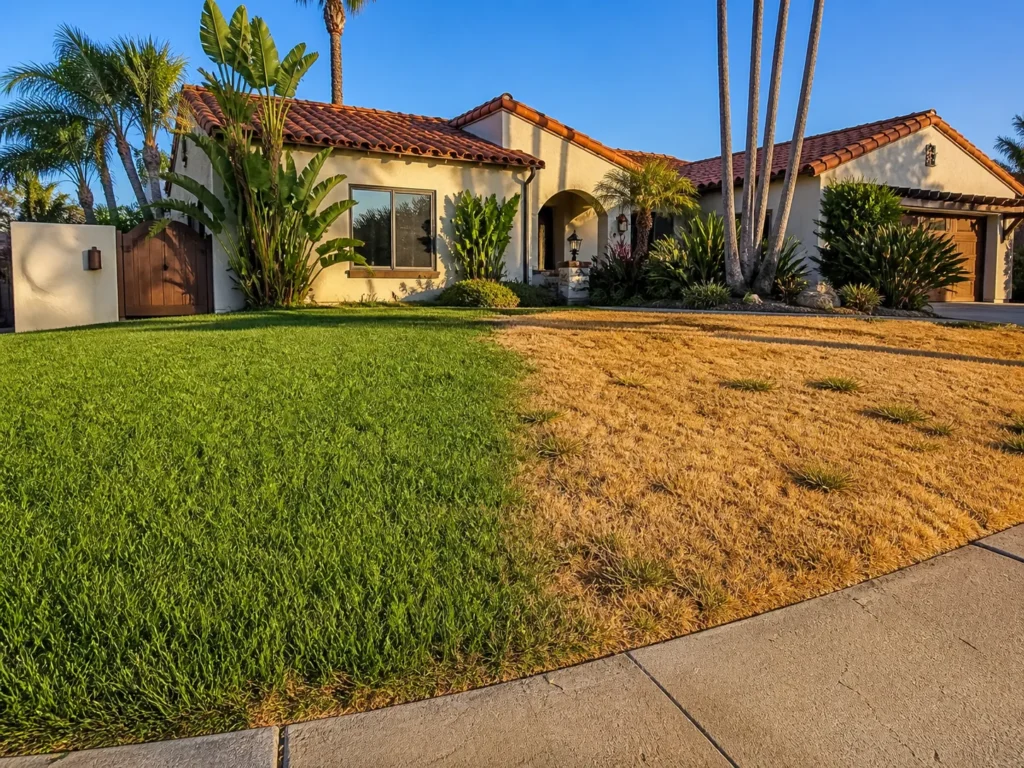
Chula Vista gets over 260 sunny days a year and barely 10 inches of rain. Yet most yards in this city are still designed like they’re in Seattle — thirsty lawns, water-hungry shrubs, sprinklers running on a schedule nobody’s adjusted since installation.
Drought tolerant landscaping Chula Vista homeowners install correctly cuts outdoor water use by 50 to 75 percent. That’s not a marketing number. It’s the documented range from San Diego County Water Authority data. We see the same range across completed projects in Eastlake, Otay Ranch, and Bonita. Over 60% of residential water use in Chula Vista goes to landscaping. That’s the biggest lever most homeowners have over their water bill.
This guide covers the whole property: front, back, and side yards. The terminology that actually matters. Chula Vista’s microclimate variation. The official city resources most homeowners never find. And the irrigation and soil mechanics that make drought tolerant landscaping work long-term. For front-yard-specific design styles and the SoCalWaterSmart rebate walkthrough, see our front yard landscaping ideas guide — this guide goes broader and deeper.
Drought Tolerant Landscaping Chula Vista Terms: What You’re Actually Choosing
These three terms get used interchangeably online. They’re not the same thing, and the difference affects what you plant.
| Term | What It Means | Water Need After Establishment |
|---|---|---|
| Drought tolerant | Survives dry periods but performs best with some regular water | Low to moderate |
| Drought resistant | Survives extended dry periods with minimal water | Very low |
| Xeriscaping | A design method using 7 principles to build a yard around available water | Depends on plant choices within the method |
Xeriscaping isn’t a plant list. It’s a system. The seven principles: planning and design, soil improvement, efficient irrigation, practical turf areas, plant selection, mulching, and maintenance. Drought tolerant landscaping Chula Vista projects that succeed apply most or all seven principles. Projects that fail usually skipped soil improvement or irrigation efficiency. They relied on plant selection alone.
One distinction matters most. Drought tolerant doesn’t mean zero water ever. Most plants, even true natives, need consistent water during their first one to two growing seasons. Roots need that time to establish. Skip this step and the plant dies before reaching its low-water mature state. This is the most common reason drought tolerant landscaping fails in its first year.
Drought Tolerant Landscaping Chula Vista: Why Microclimate Changes Your Plant List
Chula Vista isn’t a single climate zone. It sits in a transition band. Not fully coastal, not fully inland. That affects which plants thrive where on your specific property.
| Zone | Characteristics | Best Suited For |
|---|---|---|
| Western Chula Vista (near the Bay) | Coastal breeze influence, milder temperature swings, sandy-clay mix soil | Mediterranean plants, coastal sage scrub natives |
| Central Chula Vista | Mixed clay and sandy soils, moderate heat | Broadest plant palette — most flexibility |
| Eastern Chula Vista (Eastlake, Otay Ranch, Rancho Del Rey) | Inland heat 8–12°F higher in summer, clay-heavy soil, Santa Ana wind exposure | Tougher natives, succulents, drought-resistant (not just tolerant) species |
A plant that thrives in coastal-influenced Bonita may struggle in an exposed Eastlake lot. Inland heat and Santa Ana wind change everything. Generic “Southern California” guides skip this distinction entirely. Homeowners in eastern neighborhoods plant species suited for milder coastal conditions. Then they wonder why those plants struggle by August.
East of Otay Lakes Road or on an exposed hillside lot? Lean toward drought-resistant species, not just drought-tolerant ones. Skip anything described as needing regular water after establishment.
The Plant Categories Behind Real Drought Tolerant Landscaping Chula Vista Projects
A full property needs more than groundcover — and more than succulents alone. California native plants form the backbone of most successful designs. Here’s the complete category breakdown for drought tolerant landscaping Chula Vista projects, organized by function.
Trees (structure and shade):
| Tree | Water Need | Mature Height | Notes |
|---|---|---|---|
| California sycamore (native) | Low (established) | 40–80 ft | Native, fast growing, needs space |
| Desert willow | Very low | 15–25 ft | Trumpet flowers, extreme heat tolerant |
| Olive (fruitless varieties) | Very low | 20–30 ft | Mediterranean, sculptural multi-trunk option |
| Crape myrtle | Low | 15–25 ft | Summer bloom, good for smaller lots |
Trees matter more than most homeowners realize. They create shade that keeps soil moisture in place. They also reduce heat load on everything planted beneath them.
Shrubs (structure and habitat):
| Shrub | Water Need | Height | Notes |
|---|---|---|---|
| Ceanothus (California lilac) | Very low | 3–12 ft | Spring bloom, evergreen, privacy potential |
| Toyon | Low | 6–15 ft | Red winter berries, attracts birds |
| Manzanita | Very low | 1–15 ft | Sculptural, evergreen |
| Rosemary (upright) | Very low | 3–5 ft | Structure, fragrance, edible |
Ground covers (erosion control, weed suppression, water reduction):
| Ground Cover | Water Need | Spread | Notes |
|---|---|---|---|
| Dymondia | Very low | Spreading mat | Foot-traffic tolerant, lawn-strip alternative |
| Creeping thyme | Low | Spreading mat | Fragrant, light foot traffic OK |
| Sedum varieties | Very low | Spreading | Succulent, minimal care |
Perennials and accents (seasonal color):
| Plant | Water Need | Notes |
|---|---|---|
| Lavender | Very low | Fragrant, pollinator magnet |
| California poppy | Very low | Self-seeds, spring color |
| Kangaroo paw | Low | Architectural form, long bloom |
| Cleveland sage | Very low | Silver-gray foliage, deer-resistant |
This layered structure of trees, shrubs, ground covers, and accents is what separates intentional drought tolerant landscaping Chula Vista projects from one that just looks like gravel with a few cacti. Reference the San Diego County Water Authority’s Nifty 50 Plants Guide for the full regional list.
Soil Preparation: The Step Most Drought Tolerant Landscaping Chula Vista Projects Skip
Plant selection gets all the attention. Soil preparation determines whether those plants actually survive in Chula Vista’s clay-heavy ground.
Chula Vista’s soil runs from sandy-clay near the bay to dense clay inland. Clay compacts easily and drains slowly. That creates a tough environment for new roots during the critical first season.
The soil prep sequence that works:
- Test drainage: dig a 12-inch hole, fill with water, and time how long it takes to drain. Over 4 hours indicates significant clay compaction.
- Amend with compost worked into the top 6–8 inches before planting — not just at the surface
- For severe clay, apply gypsum to break up soil structure without altering pH
- Grade for drainage away from structures, especially on the clay-heavy eastern lots
- Apply mulch 2–4 inches deep immediately after planting — this single step keeps moisture in the root zone and is one of the seven xeriscaping principles for good reason
Skipping soil prep is why some installs look great for six months, then fail. Roots hit a wall of compacted clay they can’t penetrate.
Drought Tolerant Landscaping Chula Vista Irrigation: From Sprinklers to Drip
Most homeowners converting to drought tolerant landscaping keep their old spray-head system. That’s a mistake that undermines the entire project.
Spray heads broadcast water across a wide area. That’s efficient for turf but wasteful for spaced-apart drought-tolerant plants with bare mulch between them. Up to 50% of spray-head water is lost to evaporation, wind, and runoff before it reaches the roots.
Drip irrigation delivers water directly to the root zone of each plant — at the soil surface, in small, controlled amounts, with minimal evaporation loss. Drip conversion typically cuts water use another 30–50% beyond what plant selection alone achieves.
| Irrigation Type | Water Efficiency | Best For |
|---|---|---|
| Spray heads | 50–70% efficient | Turf areas only |
| Drip emitters | 90%+ efficient | Individual shrubs, trees, perennials |
| Drip line (inline emitter tubing) | 90%+ efficient | Ground cover beds, dense plantings |
| Smart/weather-based controllers | Adjusts automatically | Any system — reduces watering during cool/rainy periods |
Conversion approach: Cap or remove spray heads in converted zones. Install drip line or individual emitters sized to each plant’s mature water need. Succulents need far less than a young tree still establishing. Add a smart controller if you don’t have one. These adjust run times automatically based on weather data — no more watering on a fixed schedule through a rainy week.
Our irrigation and sprinkler repair team handles spray-to-drip conversions across Chula Vista, including smart controller installation and zone remapping for converted planting beds.
Backyard Drought Tolerant Landscaping Chula Vista: A Different Set of Choices
Front yards face HOA standards and street visibility. Backyards face different priorities — usability, privacy, how the space gets lived in.
Modern drought tolerant backyard design isn’t gravel and a single cactus. The combinations homeowners are actually choosing:
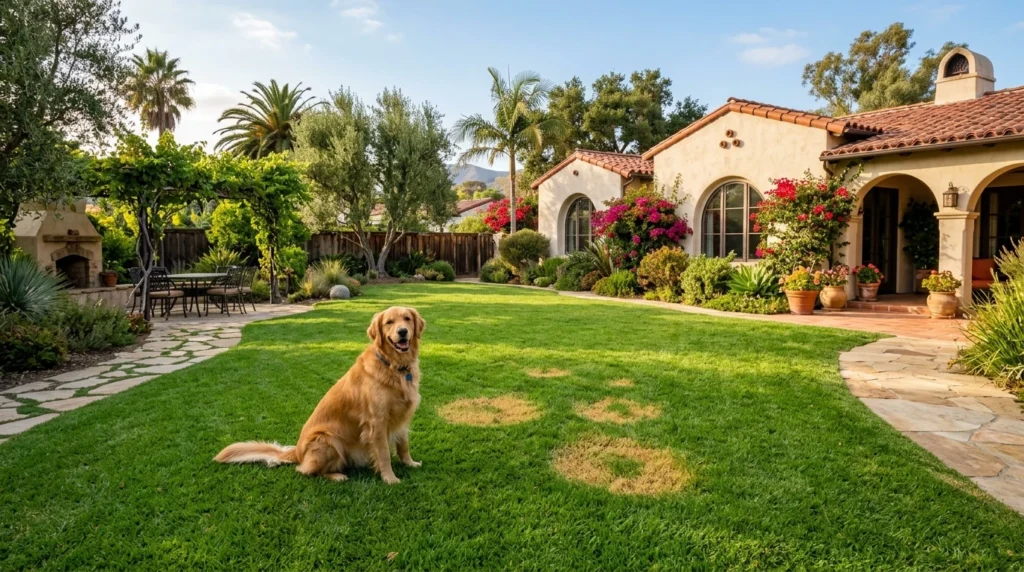
- Artificial turf + planting beds: A usable green play surface for kids or dogs, surrounded by drought-tolerant planting that needs no irrigation at all. This is one of the most requested backyard upgrades right now. Natural grass is harder to justify as water costs rise.
- Pavers + drought-tolerant plants + fire feature: Hardscape for entertaining, low-water planting beds, and an outdoor fire feature for year-round evening use. Chula Vista’s mild climate supports outdoor living nearly 12 months a year.
- Shade structure + understory planting: A pergola or shade sail over a seating area, with shade-tolerant drought-resistant plants beneath. Many ceanothus and manzanita varieties handle partial shade well.
The result still feels lush, not sparse. The key is balancing turf, hardscape, and planting density so the yard reads as designed.
Planning a full backyard conversion? Our landscaping services team designs combined hardscape and drought-tolerant planting projects for Chula Vista backyards of any size, including small-lot layouts common in Otay Ranch and Eastlake.
Official Programs Supporting Drought Tolerant Landscaping Chula Vista Homeowners Can Use
The city and regional water authority actively support this conversion. Most homeowners never use the free resources available.
NatureScape (City of Chula Vista): A five-step framework: know your yard, plan thoughtfully, choose climate-appropriate plants, maintain naturally, provide habitat. Free design workshops back it through the city’s Sustainability Division. NatureScape ties directly into Chula Vista’s Climate Action Plan and Water Stewardship Plan. Contact the Conservation Section at (619) 409-3893 or visit chulavistaca.gov/conservation.
The Nifty 50 Plants Guide: Published by the San Diego County Water Authority, this is the definitive regional plant list for water-smart landscapes. Shrubs, succulents, vines, ground covers, flowers, trees, and grasses — all selected for our climate. Cross-reference any plant list against this guide before finalizing your design.
SoCalWaterSmart turf removal rebate: $2–$3 per square foot for converting lawn to drought-tolerant landscaping. Covered in full detail, including the application process, in our front yard landscaping guide.
WaterSmart Landscaping & Water Reuse program: City-published guidance on graywater systems, rain barrels, and irrigation outlets that direct water to plants instead of broadcasting it. Useful if you want to go beyond plant selection into full water reuse.
Maintenance: What Drops, What Doesn’t
A common myth: drought tolerant means zero maintenance. It means different maintenance — far less time-consuming, but not nothing.
What drops dramatically:
- Mowing — eliminated entirely in converted lawn areas
- Watering frequency — most established native and Mediterranean plants need water every 2–4 weeks in summer, not daily
- Fertilization — natives are adapted to lean soil and rarely need feeding once established
What still needs attention:
- Weed suppression — bare mulch and gravel areas need periodic weeding until plants fill in; our weed control service handles pre-emergent treatment for new planting beds during the establishment period
- Pruning — many natives (ceanothus, sage, manzanita) need annual shaping to maintain form and prevent overgrowth
- Mulch refresh — reapply 1–2 inches annually as it breaks down, maintaining the moisture-retention benefit
- Establishment watering — the first 1–2 years require consistent attention even for drought-resistant species
The maintenance shift is real. But it’s a shift, not a disappearance.
Drought Tolerant Landscaping Chula Vista Costs in 2026
| Project Scope | Cost Range (before rebates) | Notes |
|---|---|---|
| Soil prep only (500 sq ft) | $800–$1,500 | Compost, gypsum, grading |
| Drip irrigation conversion (500 sq ft) | $1,200–$2,500 | Includes smart controller |
| Plant installation, natives (500 sq ft) | $4,000–$7,500 | 1-gallon plants, 2–3 year fill-in |
| Full design + install (front or back, 500 sq ft) | $6,000–$12,000 | Includes soil, irrigation, plants, mulch |
| Whole-property conversion (1,500+ sq ft) | $15,000–$35,000+ | Front, back, and side combined |
SoCalWaterSmart rebates reduce net cost by $2–$3 per square foot of removed turf. See our Chula Vista lawn care pricing guide for ongoing maintenance rates after installation, and our front yard landscaping guide for the full rebate application walkthrough.
FAQ: Drought Tolerant Landscaping Chula Vista — Your Questions Answered
How much water does drought tolerant landscaping actually save in Chula Vista?
50–75% reduction in outdoor water use is the documented range from San Diego County Water Authority data and matches what we see across completed Chula Vista projects. Since landscaping accounts for over 60% of residential water use here, this is the single biggest lever most homeowners have over their utility bill.
What’s the difference between drought tolerant and drought resistant plants?
Drought tolerant plants survive dry periods but perform best with some regular water even after establishment. Drought resistant plants survive extended dry periods with minimal water indefinitely. For exposed eastern Chula Vista lots (Eastlake, Otay Ranch) with inland heat, lean toward drought-resistant species specifically.
Do drought tolerant plants need watering at all once established?
Yes — typically every 2–4 weeks in summer for most established natives and Mediterranean plants, far less than a lawn’s 3x-weekly schedule but not zero. The first 1–2 growing seasons need consistent water for root establishment regardless of species.
Is drip irrigation necessary for drought tolerant landscaping, or can I keep spray heads?
Drip is strongly recommended. Spray heads lose up to 50% of water to evaporation and runoff on the spaced-out plantings typical of drought tolerant design. Drip delivers water directly to the root zone at 90%+ efficiency, cutting water use by an additional 30–50% beyond plant selection alone.
What soil preparation does drought tolerant landscaping need in Chula Vista’s clay soil?
Test drainage first — a 12-inch hole that takes over 4 hours to drain indicates significant clay compaction. Amend with compost worked into the top 6–8 inches, apply gypsum for severe clay, and grade for drainage. Skipping this step is the most common reason new plantings fail in their first year.
Can I do drought tolerant landscaping in my backyard, not just the front?
Yes, and backyard projects often combine artificial turf for usable space with drought-tolerant planting beds, hardscape, and shade structures. The design priorities differ from front yards — privacy and usability matter more than street-facing curb appeal.
Does the City of Chula Vista offer help with drought tolerant landscaping?
Yes. The NatureScape program offers free design workshops and one-on-one guidance through the Sustainability Division — contact (619) 409-3893. The San Diego County Water Authority’s Nifty 50 Plants Guide is the definitive regional plant list. SoCalWaterSmart provides the turf removal rebate covered in our front yard landscaping guide.
Where to Start With Drought Tolerant Landscaping Chula Vista Projects
Start with the soil test. Not the plant list. A 12-inch hole filled with water tells you more about your odds of success than any plant catalog.
From there: identify your microclimate zone. Choose plants matched to it, using the Nifty 50 guide as your baseline. Convert irrigation to drip before or during planting — never after. Budget for 1–2 years of establishment watering, even for drought-resistant species.
The homeowners with thriving drought tolerant landscapes in Eastlake, Otay Ranch, and Bonita didn’t get there just by buying the right plants. They did the unglamorous parts first: soil prep, irrigation conversion, realistic establishment watering. The plants were the easy part.
What’s your biggest yard challenge right now — water bill, maintenance time, or just wanting something that survives the summer without daily attention?
Serving all Chula Vista neighborhoods including Eastlake, Otay Ranch, and Bonita. CSLB licensed. Fully insured. NatureScape program partner.