Small Southern California backyards can be awkward.
One yard has a narrow concrete strip behind a townhome. Another has a 20-foot-deep patio in Otay Ranch. Another has a slope in Eastlake, clay soil, afternoon heat, and an HOA that cares more than your actual neighbors.
The good news: small yards can look better than large ones when the layout is right.
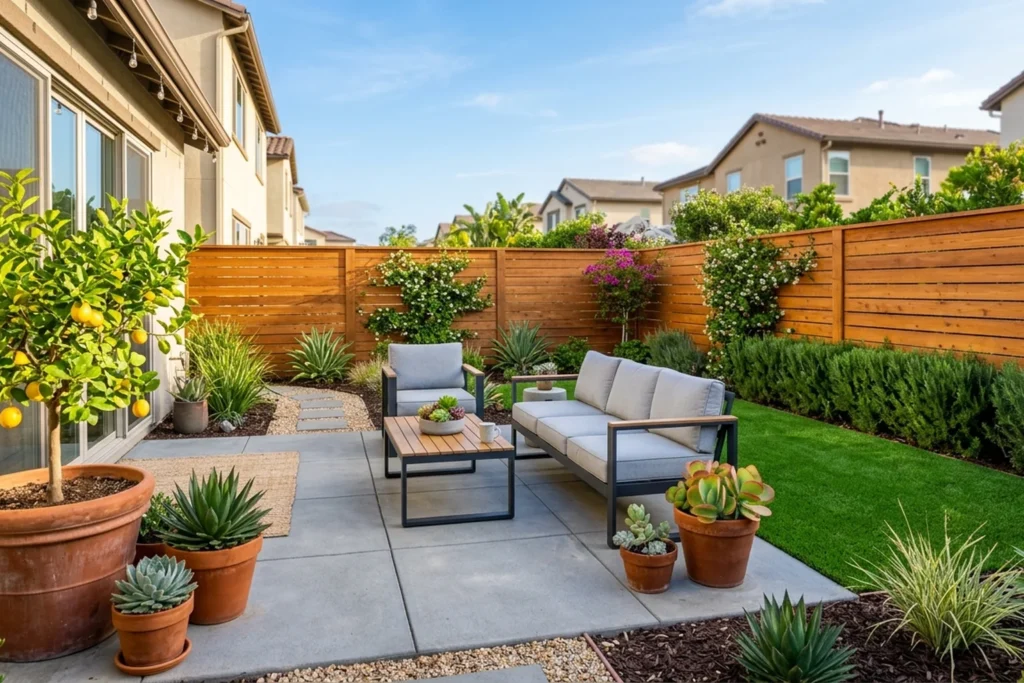
The best backyard landscaping ideas for small yards in Southern California use 3 things well: shade, hardscape, and climate-appropriate planting. You need enough structure to make the space useful. You need enough plants to soften it. And you need irrigation that does not waste water or create runoff.
This guide is written for Chula Vista, South Bay, and nearby Southern California homes. Not a magazine yard in a climate that gets summer rain.
Quick Answer: Best Small Backyard Ideas for Southern California
For most Chula Vista homes, the best backyard landscaping ideas for small yards can use are:
- A compact paver patio with planting around the edges.
- A pergola or sail shade for afternoon heat.
- Raised planters along one wall.
- Drought-tolerant plants grouped by water needs.
- One small tree for shade and vertical structure.
- Decomposed granite paths with proper base prep.
- Artificial turf only where it solves a real use problem.
- Drip irrigation instead of spray heads in planting beds.
- Built-in bench seating to save floor space.
- Low-voltage lighting for evening use.
That mix gives you outdoor living space, lower water use, and enough greenery to avoid the “all concrete” look.
Why Small Yards Are Different in Chula Vista
A small backyard in Chula Vista has a different job than a large yard in a cooler climate.
It has to survive heat.
It has to handle compact soil.
It has to use water carefully.
It often has to stay HOA-friendly.
In Eastlake, Otay Ranch, Terra Nova, Rancho Del Rey, Sunbow, and Bonita, many backyards are built around patios, side yards, block walls, slopes, and tight property lines. That changes the design.
You do not need 20 ideas. You need the right 5.
Good backyard landscaping ideas for small yards can actually use should answer these questions:
- Where will people sit?
- Where will shade come from?
- Which plants stay the right size?
- How will water reach roots without runoff?
- How much maintenance will the owner really do?
- What will the yard look like in August?
If the plan fails one of those questions, it will feel good for 2 weeks and annoying for 5 years.
1. Start With One Main Outdoor Room
Small yards get messy when every idea fights for space.
Start with one main outdoor room. That might be a dining patio, fire pit area, lounge space, grill zone, or play area. Pick one primary use before choosing plants.
For a 300-500 square foot backyard, one outdoor room is usually enough. For a 600-900 square foot yard, you may fit 2 zones if the path between them is clear.
Use this rule:
| Yard Size | Best Main Feature | What to Avoid |
|---|---|---|
| Under 300 sq. ft. | Bistro patio or built-in bench | Large turf area |
| 300-500 sq. ft. | Dining patio plus edge planting | Oversized fire pit |
| 500-800 sq. ft. | Patio plus small lawn/turf strip | Too many plant beds |
| 800-1,200 sq. ft. | Two zones with path connection | Random hardscape shapes |
The best backyard landscaping ideas for small yards share one habit: they leave open floor space.
That open area makes the yard feel larger.
2. Use Edge Planting, Not Center Planting
Planting in the middle of a small yard usually breaks up the usable space.
Plant around the edges instead.
Use the back wall, side fence, or patio border as the green zone. This keeps the center open for movement, seating, pets, or kids.
Good edge planting options for Southern California:
- Dwarf olive in a large container
- Toyon where space allows
- Cleveland sage in a sunny bed
- California fuchsia for color
- Dwarf citrus where sun and drainage are right
- Agave or aloe as sculptural accents
- Rosemary near a seating edge
- Deergrass or blue grama for soft movement
Keep mature size in mind. Chula Vista’s NatureScape guidance makes this point clearly: plant choices should fit the actual site, sun, shade, water needs, and mature size.
That matters in small yards. A “cute” 1-gallon plant can become a 6-foot problem.
3. Add Shade Before You Add More Plants
Shade is not optional in inland Chula Vista.
Afternoon sun can make a backyard unusable from June through September. A small yard without shade becomes a space people look at, not use.
Smart shade options include:
- A small pergola over the dining area
- A sail shade mounted high enough for airflow
- A narrow canopy tree
- A vine-covered trellis
- A side-yard arbor
- A patio umbrella with a stable base
If you want one tree, choose carefully. You need root behavior, mature canopy size, leaf litter, and nearby hardscape clearance to make sense.
For small yards, one well-placed tree is better than 5 random shrubs.
4. Replace Lawn With a Better Small-Yard Surface
Grass is not always wrong. But in small Southern California backyards, it often causes more work than value.
Small lawns are hard to irrigate evenly. Spray heads hit fences, patios, and walls. Corners dry out. Shady strips thin out. Dogs create wear patterns. Mowers have no room to turn.
Better options:
| Surface | Best For | Maintenance |
|---|---|---|
| Pavers | Dining and lounge space | Low |
| Decomposed granite | Paths and casual seating | Medium |
| Gravel with stepping stones | Side yards and dry gardens | Low |
| Artificial turf | Pets or play zones | Medium |
| Native groundcover | Soft green edges | Medium |
| Mulched planting beds | Water-wise gardens | Low |
If you keep turf, keep it simple. Use one clean rectangle or strip. Odd lawn shapes waste water and time.
Small-yard backyard ideas should reduce maintenance, not create tiny problem zones.
If the retained natural lawn is thin but well placed, compare repairing and renovating the grass with complete sod replacement. A new green surface will not correct deep shade or spray heads that water the patio instead of the roots.
5. Build a Patio That Fits the Furniture
Many small backyard patios fail because they were designed around leftover space, not real furniture.
Measure first.
A small bistro table may need only 6 by 6 feet. A 4-person dining table usually needs about 10 by 10 feet once chairs slide out. A lounge set often needs more depth than homeowners expect.
Before installing pavers or concrete, place painter’s tape on the ground. Walk around it. Pull chairs out. Open the grill lid. Check the door swing.
This 20-minute test can prevent a very expensive mistake.
For Chula Vista homes, permeable or well-drained hardscape is often a better choice than turning the whole backyard into solid concrete. Drainage still matters, especially on clay soil and slopes.
6. Use Raised Planters for Tight Spaces
Raised planters are one of the best backyard landscaping ideas for small yards because they create structure without eating the whole yard.
Use them for:
- Herbs near the kitchen door
- Dwarf citrus in sunny spots
- Strawberries or vegetables
- Privacy shrubs
- Color near a patio
- Separating dining and play areas
Keep planters narrow when placed along a wall. A 24-inch-deep planter can hold many herbs and compact shrubs. A 36-inch-deep planter gives larger roots more room but takes more floor space.
Use drip irrigation on a timer. Containers and raised beds dry faster than in-ground planting, especially during Santa Ana conditions.
7. Make the Side Yard Useful
Small Chula Vista yards often have narrow side spaces.
Do not waste them.
A side yard can become:
- A decomposed granite path
- A utility zone with hidden bins
- A dog run
- A vertical herb wall
- A slim planting corridor
- A storage bench area
- A gravel path with stepping stones
Keep it simple and clean. Side yards fail when they become storage piles.
Use a firm surface, clear drainage, and one vertical feature. That is enough.
8. Choose Plants That Match Southern California Reality
Southern California planting is not just about drought tolerance.
It is about the right plant in the right place.
San Diego County Water Authority describes WaterSmart landscapes as using climate-appropriate plants, healthy soil, efficient irrigation, and rainwater capture. Chula Vista’s NatureScape program gives similar advice: build healthy soil, plant for the site, and use WaterSmart irrigation.
For small yards, choose plants that stay in scale.
| Plant | Why It Works | Best Placement |
|---|---|---|
| Cleveland sage | Fragrant, drought-tolerant, pollinator value | Sunny edge bed |
| California fuchsia | Summer/fall color, hummingbirds | Dry sunny border |
| Yarrow | Low-growing flowers, good filler | Front of bed |
| Deergrass | Soft texture, low water once established | Corner or slope |
| Manzanita compact varieties | Structure and native value | Sunny, well-drained spot |
| Toyon | Native screen if space allows | Back fence |
| Agave | Strong shape, low water | Accent area |
| Aloe | Color and texture | Sunny raised bed |
| Rosemary | Edible, tough, aromatic | Patio edge |
| Dwarf citrus | Useful and attractive | Sunny container |
Native plants can also support local wildlife. UC Master Gardeners of San Diego County notes that native plants use less water, need less work, and help biodiversity.
9. Use Vertical Space for Privacy
Privacy is one of the biggest small-yard problems.
But adding a bulky hedge can shrink the yard fast.
Use vertical features instead:
- Trellis panels
- Narrow vines
- Slatted screens
- Espalier fruit trees
- Tall planters
- Bamboo only in contained planters
- Climbing roses where water and sun fit
Avoid planting aggressive vines directly against fences unless you are ready to maintain them. A small yard can go from cozy to overgrown fast.
The goal is filtered privacy, not a living wall that takes over.
10. Add Lighting for Evening Use
A small backyard often looks best at night.
Low-voltage lighting can make a compact space feel finished without adding clutter.
Use:
- Step lights for safety
- Wall wash lights for block walls
- Downlights from a pergola
- Path lights only where needed
- Warm string lights over a seating zone
Do not overlight the yard. Southern California evenings are part of the value. Use soft light, not stadium light.
11. Use Water Features Carefully
A water feature can work in a small yard, but it must earn its space.
Good options:
- Wall fountain
- Small recirculating basin
- Ceramic urn fountain
- Narrow rill-style feature
Poor options:
- Oversized pond
- High-splash fountain
- Feature placed in full sun with no shade
- Anything that blocks the main walkway
In a small yard, sound matters more than size. A quiet fountain near seating can soften neighborhood noise without using much space.
12. Plan Irrigation Before Plants Go In
Do not plant first and figure out water later.
That is how small yards get patchy.
Use hydrozones. That means grouping plants with similar water needs together. Chula Vista’s NatureScape guidance recommends separating low-water users from plants that need more irrigation.
For most small backyard landscaping projects:
- Use drip irrigation for shrubs and beds.
- Use separate zones for containers.
- Avoid spray heads near walls and patios.
- Check coverage after installation.
- Adjust schedules by season.
- Water before sunrise or after sunset.
First-year watering matters. Even drought-tolerant plants need steady water while roots establish.
After that, the yard should need less.
13. Use Mulch Like a Design Material
Mulch is not just filler.
It cools soil, reduces evaporation, limits weeds, and helps small planting beds look intentional.
Chula Vista’s NatureScape guidance notes that mulch helps moderate soil temperature, reduce evaporation, inhibit weeds, and prevent erosion.
For small yards, mulch also creates contrast with pavers, gravel, and plant foliage.
Good options:
- Shredded bark for planted beds
- Arborist wood chips for informal areas
- Gravel mulch around succulents
- Decomposed granite for paths
Keep mulch away from plant stems. Give each plant a little breathing room.
14. Keep the Palette Tight
Small yards look bigger when the material palette is tight.
Use 3 main materials:
- One paving material
- One mulch or gravel material
- One wall or wood accent
Then repeat plant forms.
For example:
- Concrete pavers
- Warm gravel
- Wood slat screen
- Deergrass
- Sage
- Agave
That is enough.
Too many colors and textures make a small yard feel like a sample board.
15. Make Room for Maintenance
Every plant grows.
Every drain needs access.
Every irrigation valve needs service.
Every grill needs clearance.
Good small-backyard landscaping leaves space for real life.
Do not plant a shrub where a gate needs to swing. Do not bury valve boxes under gravel without marking them. Do not place a planter where it blocks AC service. Do not install a fire pit too close to a fence.
The best design is the one that still works after 3 summers.
Best Small-Yard Layouts for Chula Vista Homes
Here are 4 layouts that work well in South Bay backyards.
Patio Plus Green Border
Best for townhomes, newer homes, and HOA yards.
Use pavers or concrete for the center patio. Add a 2- to 4-foot planting border around the fence line. Use drip irrigation and compact shrubs.
Why it works: high usability, clean look, easy maintenance.
Dining Zone Plus Raised Planters
Best for families who cook outside.
Place the dining area near the kitchen door. Use raised planters along one side for herbs, citrus, and flowers.
Why it works: useful, attractive, and easy to maintain.
Turf Strip Plus Shade
Best for dogs or kids.
Use one simple artificial turf or grass strip. Add a pergola or shade sail over the hardscape area. Keep planting on the edges.
Why it works: gives soft space without turning the whole yard into a lawn problem.
Dry Garden Lounge
Best for low maintenance.
Use gravel, boulders, pavers, low-water plants, and one focal tree. Add a bench or chairs.
Why it works: low water, strong style, and good for small sunny yards.
What to Avoid in a Small Southern California Backyard
Avoid these mistakes:
- Too much concrete with no shade
- Large shrubs that outgrow the space
- Spray irrigation in tiny planting beds
- Random gravel without base prep
- Artificial turf over poor drainage
- Tropical plants in full inland sun
- Too many tiny pots
- A fire pit that blocks walking space
- Vines that damage fences
- No plan for water runoff
Most failed small yards are not short on money. They are short on planning.
Cost Ranges for Small Backyard Landscaping
Costs vary by access, materials, drainage, demolition, irrigation, and plant size. A small yard can still cost real money because crews, disposal, base prep, and hardscape work do not shrink as much as the square footage.
| Project Level | Typical Scope | Budget Expectation |
|---|---|---|
| Refresh | Mulch, plants, cleanup, minor irrigation | Lower |
| Small upgrade | Planters, drip, gravel, compact planting | Moderate |
| Patio build | Pavers/concrete, base prep, drainage | Moderate to higher |
| Full redesign | Demo, hardscape, planting, lighting, irrigation | Higher |
| Premium small yard | Custom seating, pergola, lighting, drainage | Highest |
If budget is tight, do the structure first. Patio, drainage, irrigation, and soil prep should come before decorative extras.
Plants are easier to add later than hardscape is to redo.
Measure the Chula Vista Access Route Too
Before buying materials for an Otay Ranch patio or a Terra Nova side yard, measure the narrowest gate, steps, door swings, and the route from the delivery point. Mark irrigation valves, drains, utility equipment, and the clearance needed to service them. Use furniture outlines to test movement with chairs pulled out.
For an Eastlake or Rancho Del Rey property with a slope, watch where runoff goes before adding paving. Confirm any HOA review and City permit requirements for the actual structure or grading proposed rather than assuming a small yard is exempt. Fix irrigation leaks and overspray before planting and keep containers on a suitable watering schedule separate from established low-water borders.
A Simple 10-Step Plan
Use this before calling a contractor or buying plants.
- Measure the yard.
- Mark sun and shade at 9 a.m., noon, and 4 p.m.
- Choose one main use.
- Pick the patio or path location.
- Decide where shade will come from.
- Keep planting on edges.
- Choose 5-7 plant types maximum.
- Group plants by water needs.
- Plan drip irrigation.
- Add lighting last.
This is how backyard landscaping ideas for small yards become an actual design instead of a shopping list.
When to Call a Local Landscaper
DIY is fine for containers, small plantings, mulch, and simple cleanup.
Call a professional if you need:
- Drainage correction
- Paver or patio installation
- Irrigation redesign
- Artificial turf installation
- Slope work
- Retaining edges
- Lighting
- HOA-ready design
- Plant selection for difficult exposure
Chula Vista yards have local quirks: clay soil, hot inland pockets, coastal influence in some areas, slope runoff, and water-use expectations. A generic plan from a national site will not catch all of that.
Need help turning a small backyard into usable space? Call Chula Vista Lawn Care at (619) 604-8495 or ask about our landscaping services in Chula Vista.
We also help with professional lawn care in Chula Vista, regular lawn care services, drought tolerant landscaping, front yard landscaping ideas, and irrigation repair.
For neighborhood-specific help, see our service areas for Eastlake, Otay Ranch, Rancho Del Rey, Terra Nova, and all Chula Vista service areas.
FAQ
What is the best landscaping for a small backyard in Southern California?
The best small backyard design usually combines a compact patio, edge planting, shade, drip irrigation, and climate-appropriate plants. This gives you usable space without creating a high-water lawn problem.
How do I make a small backyard look bigger?
Keep the center open, plant along the edges, use one main patio surface, add vertical privacy, and repeat a small plant palette. Curved paths and layered planting can help, but clutter makes the yard feel smaller.
Should I use artificial turf in a small Chula Vista backyard?
Artificial turf can work for dogs, kids, or a clean green strip. It is not always the best choice for full-yard coverage. Drainage, heat, odor control, and base prep matter.
What plants work best in small Southern California yards?
Compact drought-tolerant plants work best. Good options include Cleveland sage, California fuchsia, yarrow, deergrass, compact manzanita, agave, aloe, rosemary, and dwarf citrus in sunny containers.
Is gravel good for small backyard landscaping?
Gravel can work well for paths and dry garden areas, but it needs proper base prep and edging. Do not spread gravel over weeds or compacted soil and expect a finished landscape.
How much lawn should a small backyard have?
Only keep lawn where it has a clear purpose. For many small Chula Vista yards, a small rectangle or strip works better than an irregular lawn shape that is hard to water and mow.
What is the lowest-maintenance backyard idea?
A dry garden lounge with pavers, gravel, mulch, drip irrigation, low-water plants, and one shade feature is usually the lowest-maintenance option for Southern California.
Do drought-tolerant plants need watering?
Yes, especially during the first year. Drought-tolerant plants need regular water while roots establish. After establishment, many need much less irrigation than traditional lawns.