
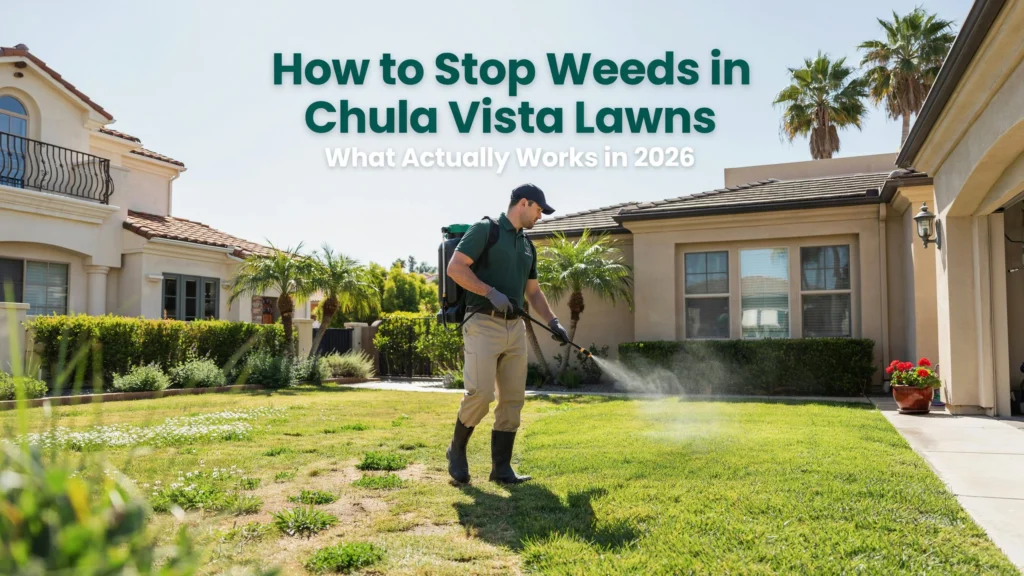
Weed control Chula Vista lawn care fails for one reason: timing. Most homeowners apply the right products three weeks too late. By then, crabgrass has already germinated, spotted spurge is spreading across the driveway edge, and nutsedge has rooted deep enough to laugh at any post-emergent spray. This guide covers the exact timing, products, and sequences that work for Chula Vista’s climate — not advice written for the Midwest.
We’ve been treating weeds on Chula Vista lawns since 2003. Here’s what we actually see every season.
Why Weed Control in Chula Vista Lawns Is Different
Chula Vista’s climate creates weed pressure all year. There is no true winter kill here. Annual bluegrass (Poa annua) thrives through December and January. Summer weeds like crabgrass and spotted spurge germinate early — sometimes by mid-February — because inland soil temperatures climb faster than national guides assume.
Three factors make weed control Chula Vista lawn care uniquely challenging:
| Factor | Impact on Weed Pressure |
|---|---|
| Year-round mild climate | No cold kill — winter weeds never freeze |
| Clay soil in most 91911/91913/91915 zip codes | Compacted surface creates bare spots where weeds invade |
| Otay Water District watering cycles | Wet/dry irrigation patterns stimulate weed seed germination |
| Bermuda dormancy (Nov–Feb) | Thin dormant turf leaves openings for Poa annua and chickweed |
| Coastal moisture from marine layer | Overnight humidity promotes spurge and oxalis root establishment |
The bottom line: effective weed control Chula Vista lawn maintenance requires two treatment windows per year — not one. Spring and fall. Miss either window and you fight reactive battles all season.
The 7 Weeds Most Common in Chula Vista Lawns (And How to ID Them)
You cannot treat what you can’t identify. Broadleaf weeds need different products than grassy weeds. Grassy weeds need different timing than perennial weeds. Getting this wrong wastes money and can damage your turf.
| Weed | Type | When It Peaks | Visual ID | Grass Safe? |
|---|---|---|---|---|
| Crabgrass | Annual grassy | June–September | Wide low-spreading blades, crab-leg branching | Bermuda: yes (pre-emergent). Fescue: yes (pre-emergent) |
| Spotted spurge | Annual broadleaf | May–October | Tiny oval leaves, milky sap when broken, flat mat growth | Both: yes with selective broadleaf herbicide |
| Nutsedge (yellow/purple) | Perennial sedge | April–October | Triangular stem, glossy leaves, grows faster than grass | Both: yes with Sedgehammer or Halosulfuron |
| Poa annua (annual bluegrass) | Annual grassy | November–March | Light green, soft, clumping — blooms in winter | Both: pre-emergent in fall prevents it |
| Oxalis (wood sorrel) | Perennial broadleaf | Year-round | Clover-like leaves, small yellow flowers | Both: post-emergent broadleaf selective |
| Dandelion | Perennial broadleaf | October–May | Deep taproot, toothed leaves, yellow flower | Both: post-emergent selective broadleaf |
| Chickweed | Annual broadleaf | November–March | Small oval leaves, tiny white flowers, low-growing | Both: fall pre-emergent or post-emergent broadleaf |
Field observation: In Eastlake Greens and Otay Ranch, spotted spurge along driveway edges accounts for more than 60% of the weed complaints we receive May through September. It establishes in the 2-inch strip of bare soil between concrete and grass faster than any other weed species. Hand-pulling works only when plants are under 2 inches. Beyond that, targeted post-emergent is needed.
The Chula Vista Pre-Emergent Calendar: Two Windows That Matter
Pre-emergent herbicides create a chemical barrier in the soil. They stop weed seeds from germinating. They do not kill existing weeds. Timing is everything — the barrier must be in place before seeds germinate.
National guides say apply pre-emergent in March. That is too late for Chula Vista.
Chula Vista’s inland temperatures push soil temps above 55°F — the crabgrass germination threshold — as early as mid-February in the 91913 and 91915 zip codes. Applying pre-emergent in March means crabgrass is already germinating when your product hits the soil.
| Application Window | Target Weeds | Timing for Chula Vista | Product Options |
|---|---|---|---|
| Spring pre-emergent | Crabgrass, spurge, goosegrass | Late January – mid-February | Prodiamine 65 WDG, Dimension 0.25G, Barricade |
| Fall pre-emergent | Poa annua, chickweed, oxalis | September – early October | Prodiamine, Dimension, Specticle Flo (Bermuda only) |
Spring application protocol for Chula Vista:
- Apply when 4-day air temperatures average 55–65°F
- Water in within 24 hours — activation requires soil moisture
- Do not aerate after application — breaks the barrier
- Do not overseed within 8–10 weeks of most pre-emergent products
Fall application protocol:
- Apply in September when soil temps drop below 70°F
- Critical for preventing Poa annua — the #1 winter weed in Chula Vista turf
- If you want to overseed with ryegrass for winter color, skip or delay fall pre-emergent — it will prevent ryegrass germination too
This is the most common mistake we see in weed control Chula Vista lawn programs: homeowners apply a fall pre-emergent in October, then try to overseed with ryegrass two weeks later. The herbicide kills the ryegrass seed. You lose both.
Pre-Emergent Products: What Works on Chula Vista Lawns
| Product | Active Ingredient | Safe for Bermuda | Safe for Fescue | Notes |
|---|---|---|---|---|
| Prodiamine 65 WDG | Prodiamine | ✅ Yes | ✅ Yes | Best value, broad-spectrum. Mix at 0.5–0.75 oz per 1,000 sq ft |
| Dimension 0.25G | Dithiopyr | ✅ Yes | ✅ Yes | Granular — easier DIY application, slight post-emergent activity on young crabgrass |
| Barricade 4FL | Prodiamine | ✅ Yes | ✅ Yes | Liquid concentrate, same AI as Prodiamine 65 |
| Specticle Flo | Indaziflam | ✅ Yes | ❌ No | Premium, longest residual (5–7 months). Bermuda lawns only |
| 0-0-7 Crabgrass Preventer | Dimension | ✅ Yes | ✅ Yes | Weed-and-feed option. Lower concentration than straight Dimension |
Avoid applying any pre-emergent to Bermuda grass within 6–8 weeks of overseeding. Most products will prevent Bermuda seed germination along with weed seeds. Time your application accordingly.
Post-Emergent Weed Control for Chula Vista Lawns
Pre-emergent missed a window? Already have weeds growing? Post-emergent products target existing weeds after germination. Product selection depends on your grass type and the weed category.
For Bermuda Grass Lawns
Bermuda tolerates a wider range of herbicides than most turf types. This gives you more options.
| Weed Category | Recommended Product | Application Notes |
|---|---|---|
| Broadleaf weeds (dandelion, spurge, clover, chickweed) | Celsius WG, Triclopyr, Speedzone Southern | Apply when weeds are actively growing. Avoid during Bermuda dormancy |
| Grassy weeds (crabgrass, dallisgrass, goosegrass) | Celsius WG, Quinclorac (Drive XLR8) | Two applications 2–3 weeks apart often needed for mature plants |
| Nutsedge (yellow or purple) | Sedgehammer (Halosulfuron), Certainty | Do NOT pull nutsedge — tubers fragment and multiply. Treat chemically |
| Bermuda + all broadleaf + grassy weeds | Celsius WG + Certainty (combo) | Covers 99% of Chula Vista weed species without harming Bermuda |
What we use: On most Bermuda lawns in Chula Vista, the Celsius WG and Certainty combination handles the full weed spectrum — broadleaf, grassy, and nutsedge — in a single program. It’s more expensive upfront than off-the-shelf products. But two applications cover a full season at a cost comparable to four rounds of cheaper products that work less reliably.
For Tall Fescue Lawns
Fescue requires different weed control Chula Vista lawn herbicide choices. Many products safe for Bermuda will damage or kill fescue.
| Weed Category | Bermuda-Safe Products (AVOID on fescue) | Safe for Fescue |
|---|---|---|
| Grassy weeds | Celsius WG (damages fescue) | Fenoxaprop (Acclaim Extra), Quinclorac |
| Bermuda grass invasion in fescue | — | Fusillade II, Ornamec (selective for fescue) |
| Broadleaf weeds | Most broadleaf selectives safe | Trimec, Speedzone, Weed-B-Gon |
| Nutsedge | Certainty (low fescue risk — check label) | Sedgehammer |
This is where Chula Vista lawn weed control gets complicated. Many Chula Vista properties have a mix of Bermuda and fescue — either by design or because Bermuda has invaded a fescue lawn. Treating this combination requires knowing which grass occupies which area and applying products accordingly. Getting it wrong kills the wrong grass.
The Nutsedge Problem in Chula Vista
Nutsedge is the most persistent weed control Chula Vista lawn challenge. It is the most difficult weed to eliminate in San Diego County lawns — and one of the most commonly misidentified.
Why nutsedge is different:
- It is a sedge, not a grass. Selective grass herbicides do not affect it.
- It spreads through underground tubers (nutlets). Pulling the plant snaps the stem and leaves tubers behind. Each tuber generates a new plant.
- It grows faster than Bermuda grass in summer heat. An untreated patch doubles in size every 3–4 weeks in Chula Vista’s inland summer.
- San Diego County’s mild winters mean nutsedge doesn’t fully go dormant. It just slows down.
What actually works:
- Sedgehammer (Halosulfuron-methyl): The most reliable product for yellow and purple nutsedge in Chula Vista lawns. Apply as a directed spray when nutsedge is actively growing. Two applications 6–8 weeks apart are needed for full suppression. Do not pull plants between applications.
- Certainty (Sulfosulfuron): Broad-spectrum sedge and grassy weed control. Effective on nutsedge and safe for both Bermuda and fescue at labeled rates.
- Patience: Even with correct chemical treatment, established nutsedge colonies take 2–3 growing seasons to eliminate. The tuber bank in the soil outlasts a single treatment.
Do not:
- Pull nutsedge manually (fragments and spreads tubers)
- Apply glyphosate near desired grass (non-selective, kills everything)
- Ignore isolated plants (a single plant produces hundreds of tubers in one season)
Why Dense Turf Is Your Best Weed Defense
The most important weed control tool in Chula Vista isn’t in a bottle.
Healthy, dense turf physically prevents weed germination. Weed seeds need sunlight to germinate. A thick Bermuda canopy at 1.5–2 inches blocks that sunlight. Bare patches from drought stress, dog urine damage, compaction, or scalping are where weeds gain footholds.
The cultural weed control checklist for Chula Vista lawns:
- [ ] Mow weekly (April–October) — never scalp, never remove more than one-third of blade height
- [ ] Aerate annually in spring — clay soil compaction creates bare surface areas where weeds establish
- [ ] Water deeply and infrequently — shallow frequent watering keeps the top inch moist, which is exactly where weed seeds germinate
- [ ] Fertilize on schedule — nitrogen-deficient turf thins out and loses the shade advantage over weed seeds
- [ ] Fix bare patches within 2 weeks — a bare patch left for 3+ weeks will have weed seedlings before it has new grass
Homeowners who invest in weed control Chula Vista lawn programs but skip aeration fight weeds forever. The biology is simple: thin stressed turf creates the openings weeds need. Remove the openings first.
Need help assessing your weed situation? Our weed control service covers diagnosis, treatment, and program timing across all Chula Vista neighborhoods. We identify weed species, assess turf density, and apply the right product at the right time. See current pricing →
California Pesticide Rules: What Chula Vista Homeowners Need to Know
California has the strictest pesticide regulations in the country. Most homeowners applying herbicides from a garden center are using general-use pesticides — these are legal for any adult to apply to their own property.
The dividing line: Restricted-use pesticides require a California Department of Pesticide Regulation (CDPR) license. Most products available at Home Depot, Lowe’s, and online retailers (Prodiamine 65 WDG, Dimension, Sedgehammer, Celsius WG) are general-use. Products like Specticle Flo are also general-use for homeowners, though some distributors limit sales.
When professional application matters:
- Treating right-of-way areas (parkway strips between sidewalk and curb) may require contractor licensing in some Chula Vista HOA communities
- High-concentration restricted-use products are more effective but require licensed application
- Any herbicide applied as part of a paid service requires a California Qualified Applicator License or Pest Control Business License (CSLB)
We handle weed control Chula Vista lawn treatments with all required California licenses and carry full general liability and workers’ compensation coverage. When you hire a Chula Vista weed control company, ask for proof of licensing before any chemical is applied on your property.
Weed Control Timing: Full Annual Program for Chula Vista
| Month | Action | Notes |
|---|---|---|
| January | Pre-emergent window opens (warm years) | Check soil temp — apply at 55°F air average |
| February | Spring pre-emergent — primary window | Most important application of the year |
| March | Post-emergent for winter weeds still present | Poa annua, chickweed, oxalis |
| April | Monitor crabgrass germination | Second pre-emergent dose if needed (8–10 weeks after first) |
| May | Spot-treat spotted spurge along edges | Driveway strips are highest-risk zones |
| June | Nutsedge treatment begins if present | Sedgehammer round 1 |
| July | Second nutsedge treatment if needed | 6–8 weeks after first application |
| August | Monitor for dallisgrass and goosegrass | Post-emergent grassy weed treatment |
| September | Fall pre-emergent — second window | Prevents Poa annua and chickweed |
| October | Post-emergent for any surviving broadleaf weeds | Treat before winter rain encourages germination |
| November | Reduce irrigation — lower water reduces winter weed pressure | — |
| December | Dormancy monitoring only | Note any winter weed establishment for February action |
This two-window, year-round weed control Chula Vista lawn program is how our lawn care services eliminate reactive weed fighting for Chula Vista homeowners. One or two pre-emergent applications plus targeted post-emergent treatment handles 85–90% of weed pressure. The remaining 10–15% is nutsedge and mature perennials — which respond to targeted chemical programs rather than broadcast spray.
Weed Control for Specific Chula Vista Neighborhoods
Weed control Chula Vista lawn pressure varies by neighborhood based on soil type, HOA watering schedules, and irrigation infrastructure age.
| Neighborhood | Most Common Weed Pressure | Primary Cause | Best First Action |
|---|---|---|---|
| Eastlake Greens/Trails | Spotted spurge along hardscape edges | Clay soil compaction at surface | Pre-emergent + driveway-edge post-emergent |
| Otay Ranch | Crabgrass in high-traffic zones | Sandy topsoil mix, higher traffic | February pre-emergent timing critical |
| Bonita | Nutsedge and oxalis | Higher water table, mature trees | Sedgehammer program |
| Rancho Del Rey | Poa annua in winter | Older irrigation systems, overwatering | Fall pre-emergent + irrigation audit |
| Terra Nova | Dandelion and broadleaf weeds | Older lots, less maintained turf density | Post-emergent broadleaf + aeration |
| Sunbow | Bermuda invasion in fescue beds | Bermuda spreading from adjacent lawns | Fusillade or Ornamec for selective removal |
We serve all Chula Vista neighborhoods including Eastlake, Otay Ranch, and Bonita — with different pre-emergent timing and product programs based on each area’s dominant weed species.
Got nutsedge taking over your Otay Ranch or Bonita lawn? This is a 2–3 season program, not a one-shot fix. Our weed control specialists start with species identification, then build a seasonal suppression program. Contact us for a weed assessment →
FAQ: Weed Control Chula Vista Lawn — Your Questions Answered
What is the best time to apply pre-emergent weed control in Chula Vista?
Late January through mid-February for spring application — earlier than most national guides recommend. Chula Vista’s inland temperatures push soil temps above 55°F (crabgrass germination threshold) as early as February. Applying in March is often too late. The fall window is September through early October.
What kills weeds but not Bermuda grass in Chula Vista lawns?
The Celsius WG and Certainty combination eliminates broadleaf weeds, grassy weeds, and nutsedge without harming Bermuda grass. For single-category control: Prodiamine or Dimension for pre-emergent prevention, Drive XLR8 for post-emergent grassy weeds, and Sedgehammer for nutsedge specifically.
How do I get rid of nutsedge in my Chula Vista lawn?
Chemical treatment only — do not hand-pull. Pulling fragments underground tubers, spreading the infestation. Apply Sedgehammer (Halosulfuron) or Certainty (Sulfosulfuron) when nutsedge is actively growing. Plan two applications 6–8 weeks apart. Expect 2–3 growing seasons to fully suppress established colonies.
Why do weeds keep coming back after I spray them?
Three reasons. First: the wrong product for the weed type (broadleaf herbicide on grassy weeds, for example). Second: no pre-emergent in the program — you kill today’s weeds but tomorrow’s seeds germinate freely. Third: thin turf gives weeds space to reestablish. Dense healthy turf is the long-term solution.
Can I apply weed killer to a Chula Vista lawn with both Bermuda and fescue?
Yes — but carefully. The grasses require different products. Celsius WG is safe for Bermuda but damages fescue. Fenoxaprop is safe for fescue. Map which grass occupies which area before applying anything. We do this assessment as part of every weed control Chula Vista lawn evaluation.
Is it safe to apply pre-emergent and fertilizer at the same time?
Yes. Weed-and-feed products combine fertilizer with pre-emergent active ingredients (Dimension is common). Applying separate products simultaneously is also fine — apply fertilizer first, then pre-emergent, water both in. Timing between products does not affect efficacy when applied same-day.
How much does professional weed control cost in Chula Vista?
Quarterly weed control programs run $45–$85 per treatment for standard residential yards. A full-year program (4 treatments including both pre-emergent windows) costs $180–$340 annually. Nutsedge-specific programs requiring multiple visits run higher. See our Chula Vista lawn care pricing page for current rates.
What’s the difference between pre-emergent and post-emergent herbicide?
Pre-emergent creates a soil barrier that prevents weed seeds from germinating — it does not kill existing weeds. Post-emergent kills weeds already growing above the soil surface. An effective weed control Chula Vista lawn program uses both: pre-emergent to prevent, post-emergent to eliminate what breaks through.
The Bottom Line on Weed Control in Chula Vista
Every Chula Vista lawn that stays consistently weed-free has one thing in common: a February pre-emergent application was made before crabgrass germinated. That one action — timed correctly — eliminates 60–70% of summer weed pressure.
The homeowners losing the weed control Chula Vista lawn battle typically missed that February window. Or they applied a spring pre-emergent in March. Or they skipped the fall application and let Poa annua establish through December. Or they pulled nutsedge by hand and spread the tubers.
None of these are difficult mistakes to avoid. They just require knowing Chula Vista’s specific timing — not generic national lawn care advice.
Weed control Chula Vista lawn maintenance is a calendar problem — not a product problem. Get the timing right and the products work. Get it wrong and even the best products in the world can’t overcome the head start the weeds already have.
What weed species are you seeing most in your lawn right now — and which month did the pressure start?